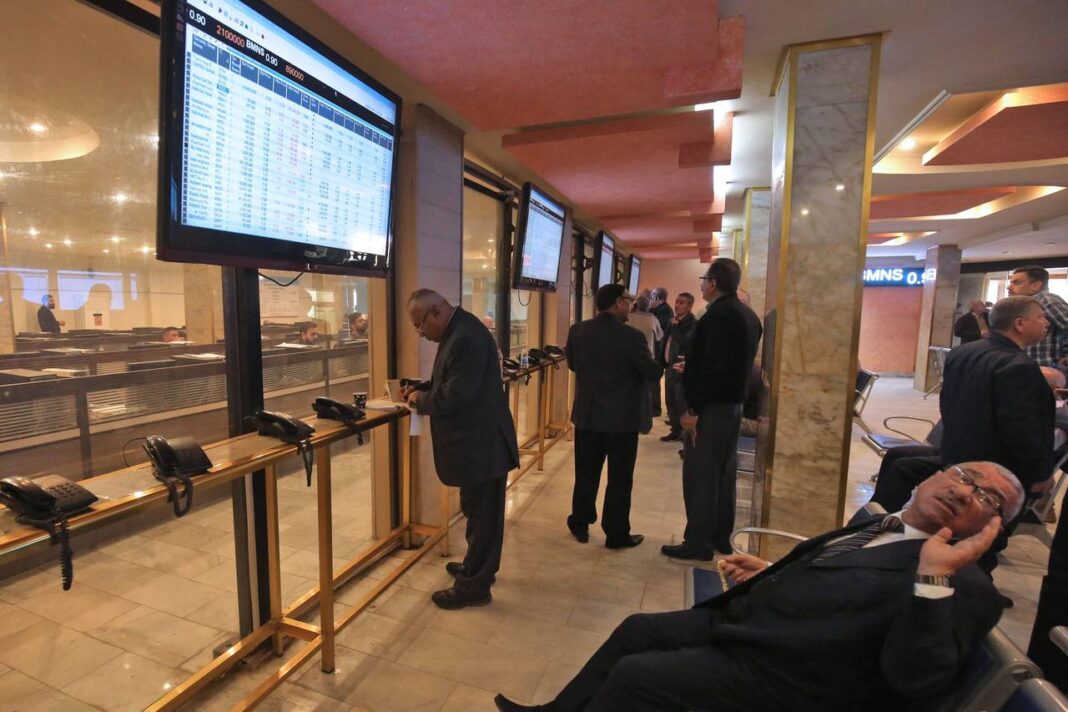
Iraq stock trading reached 390.35 billion dinars during the latest reporting period. The total equals approximately $296.67 million based on the reported conversion. Moreover, investors exchanged 389.46 billion shares across the market. The figures highlight growing activity on the country’s main securities exchange.
The Iraq Stock Exchange completed 112 trading sessions during the period. Investors traded shares in 90 companies from the exchange’s 120 listed businesses. Meanwhile, 37 brokerage firms processed transactions through the electronic trading system. These firms completed 119,375 separate deals for investors.
The total trading value measures the combined value of all exchanged shares. It does not represent profit for the exchange or participating investors. Nevertheless, the figure provides an important measure of market activity. Higher trading values often indicate stronger investor participation and liquidity.
The exchange’s two main indexes also recorded notable gains. The ISX60 index closed at 1,019.39 points after gaining 5.56 percent. Furthermore, the ISX15 index finished at 1,273.79 points. It achieved a stronger increase of 16.52 percent against the comparable period.
The ISX15’s performance suggests strong demand for several major listed companies. This index follows a smaller group of highly active businesses. Therefore, its sharp increase may reflect investor confidence in leading market shares. However, individual companies may have recorded different results.
The broader ISX60 index also delivered positive market growth. Its advance shows that gains extended beyond the largest companies. Additionally, the increase provides investors with another sign of improving market sentiment. Continued growth could attract more domestic and international participation.
Banks often dominate trading activity on Iraq’s stock market. However, investors can also access telecommunications, industry, agriculture, tourism, and insurance companies. This range allows traders to invest across several economic sectors. Furthermore, a diverse market can reduce dependence on one industry.
Despite the overall gains, 22 listed companies recorded no trading activity. The exchange also kept eight other companies under suspension throughout the period. Therefore, investors concentrated their activity among 90 active companies. This pattern shows that market participation remains uneven.
Inactive companies can face limited investor demand or weak share availability. Meanwhile, suspensions can result from regulatory, reporting, or corporate requirements. The exchange must address these issues to increase overall market participation. Greater company activity could also improve market depth and liquidity.
Electronic trading played an important role in processing the reported transactions. The system connected investors with licensed brokerage firms across the country. Consequently, brokers could complete thousands of transactions more efficiently. Digital systems also help exchanges improve speed, transparency, and recordkeeping.
However, Iraq’s market remains relatively small compared with larger regional exchanges. Markets in neighboring Gulf countries often record much higher trading values. Nevertheless, Iraq has significant room for long-term financial market growth. Economic reforms could encourage more companies to offer shares publicly.
Private businesses may consider stock listings when they seek new investment capital. Public listings can help companies finance expansion without relying entirely on bank loans. Moreover, shareholders can gain access to growing Iraqi businesses. Stronger listings could therefore support private-sector development.
Foreign investors may also monitor the improving index results. However, they often consider currency stability, regulations, transparency, and political conditions. Clearer financial reporting could strengthen their confidence in Iraqi companies. Additionally, stronger investor protection could encourage more international participation.
The exchange can also support Iraq’s efforts to diversify its economy. Iraq continues to depend heavily on oil revenue and government spending. Therefore, stronger capital markets could channel private savings into productive companies. They could also help businesses expand and create employment.
The latest Iraq stock trading figures show significant transaction volume and positive index growth. However, inactive and suspended companies continue to limit broader participation. Further reforms could help the exchange attract new investors and listings. Stronger market access could also increase liquidity across more companies.
Overall, the reported results signal positive momentum for Iraq’s financial market. Both major indexes recorded gains, while trading value exceeded $296 million. Moreover, investors completed more than 119,000 transactions through licensed brokerage firms. These figures could strengthen confidence in Iraq’s developing capital market.