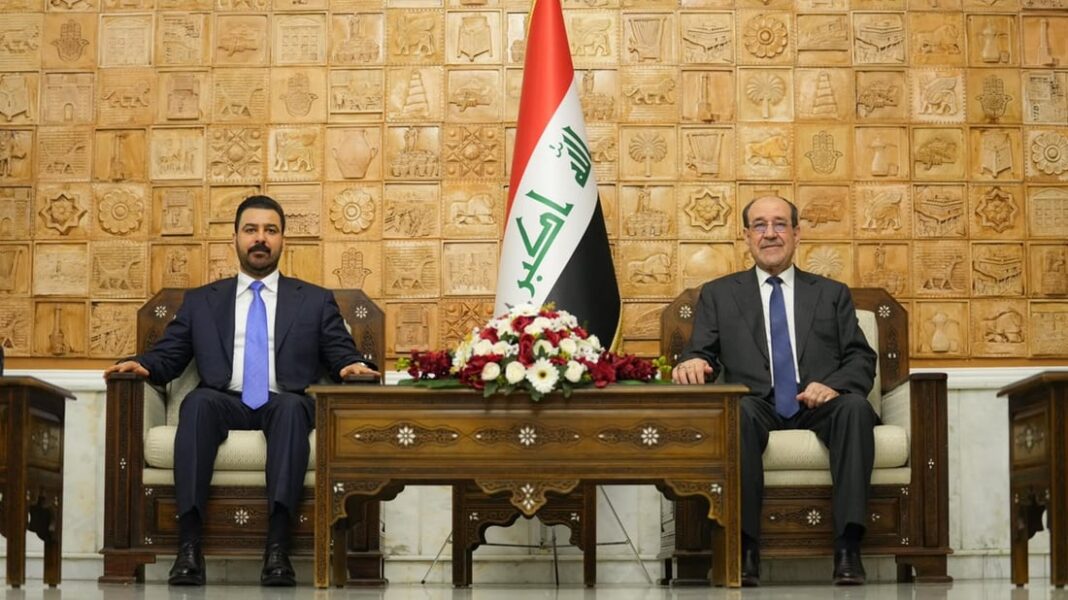
Prime Minister Ali al-Zaidi and State of Law leader Nouri al-Maliki met Saturday to discuss completing Iraq’s government lineup, with nine ministerial posts still vacant nearly four months after parliament approved the first group of cabinet nominees.
During the meeting, the two senior political figures reviewed several domestic political issues and Iraq’s broader situation. They also stressed the importance of filling the remaining positions in a way that strengthens government performance and helps the cabinet implement its executive program.
Parliament approved 14 ministers on May 14, allowing the government to begin operating with a partial cabinet. However, lawmakers did not approve nominees for several key ministries. These included planning, culture, construction and housing, higher education, and interior.
Meanwhile, parliament postponed voting on nominees for defence, labour and social affairs, migration, and youth and sports. As a result, nine ministries remain without permanent ministers, creating continued pressure on the government to reach political agreements.
Zaidi has repeatedly signaled that negotiations are approaching their final stage. On Aug. 11, he told leaders of the Coordination Framework that the cabinet formation process was close to completion. More recently, the prime minister said political discussions would conclude soon before the government submits the remaining nominations to parliament for approval.
However, negotiations continue to face disagreements among political blocs. State of Law lawmaker Duha al-Qasir said last week that discussions could extend beyond Sept. 30. She also pointed to delays surrounding several important portfolios.
According to al-Qasir, the Hasm Alliance had not yet submitted candidates for the defence ministry. Meanwhile, political groups had yet to put forward nominees for labour and social affairs. The coalition, however, submitted candidates for the interior and higher education ministries in late August.
Therefore, the government still needs to overcome several political hurdles before completing Iraq’s government lineup. The process requires competing blocs to agree on candidates who can secure enough parliamentary support.
At the same time, Zaidi has continued meeting political leaders to build consensus around the remaining appointments. On Aug. 28, he met Hikma Movement leader Ammar al-Hakim, with both sides emphasizing the need to finalize the cabinet.
The latest meeting with Maliki comes as the government faces pressure to strengthen its administration and move forward with its executive priorities. Filling the vacant ministries would give the cabinet a more complete structure and could help reduce delays in implementing government policies.
Nevertheless, the final outcome depends on negotiations between Iraq’s political blocs and parliament’s approval of the proposed candidates. With the Sept. 30 deadline approaching, attention will now focus on whether the remaining factions can settle their differences and present a unified list of nominees.
For Zaidi, completing Iraq’s government lineup remains a key political priority as his administration seeks to move beyond the prolonged cabinet formation process and focus fully on governing.