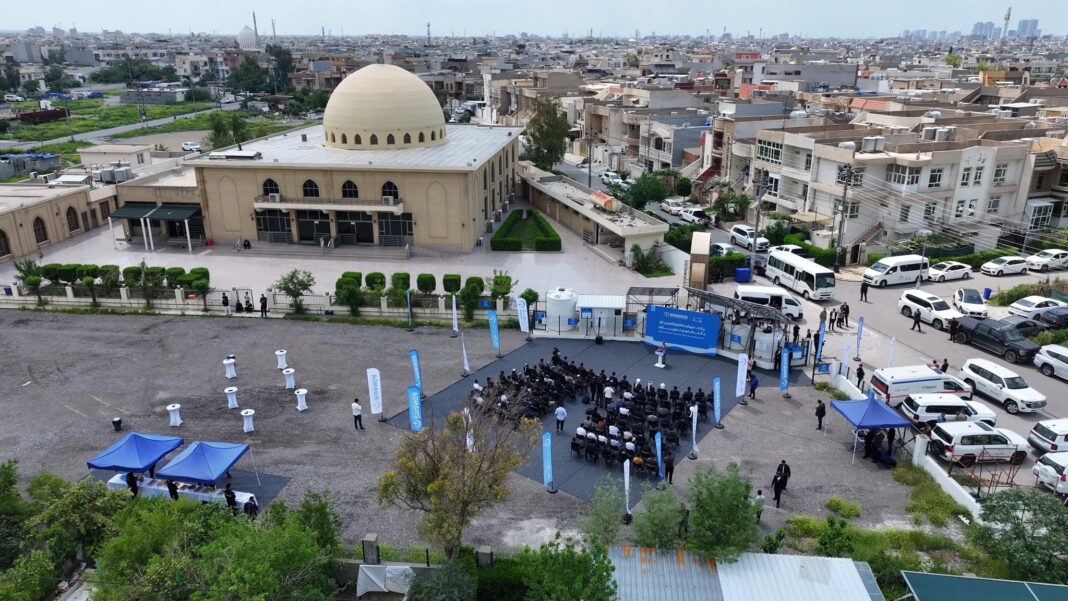
The water recycling system launched by The Rwanga Foundation at Haji Jabbar Braghi Mosque marks a major environmental step in Erbil. Furthermore, the initiative combines renewable energy, scientific innovation, and water conservation inside a community religious space.
Rwanga Foundation officially inaugurated the advanced wastewater treatment and rainwater harvesting project at the mosque in Erbil. Additionally, the opening ceremony gathered representatives from the Union of Islamic Religious Scholars in the Kurdistan Region, the Erbil district administration, university professors, and religious figures.
The project focuses on reducing water waste while promoting sustainable environmental practices. Moreover, the initiative presents a practical example of how modern science can support community development and environmental responsibility.
Engineers designed the water recycling system using eight scientific and technical purification stages. As a result, the system treats used ablution water and collected rainwater efficiently. The purified water then meets international standards for irrigation and mosque cleaning purposes.
The facility currently processes around 3,000 liters of water daily. However, the capacity rises significantly during Fridays and rainy periods. On peak days, the project can recycle up to 10,400 liters of water. Consequently, the system saves nearly 28,400 liters of water every week.
The project also operates through renewable energy sources. Therefore, 18 high-performance solar panels power the entire facility. This approach supports carbon-neutral operations while reducing environmental impact across the mosque complex.
Organizers described the initiative as a strong example of cooperation between faith and science. Additionally, environmental experts stressed the growing importance of water conservation across Iraq and the Kurdistan Region.
The project supports irrigation and sanitation activities inside the mosque complex. As a result, the mosque reduces dependence on fresh water supplies while maintaining hygiene standards.
Community members welcomed the initiative during the inauguration ceremony. At the same time, university professors highlighted the educational value of sustainable projects for younger generations.
Rwanga Foundation stated that environmental sustainability remains a long-term priority. Furthermore, the organization hopes similar projects will encourage broader cooperation between civil society groups, religious institutions, and local authorities.
The water recycling system now stands as one of the most innovative sustainability projects inside a mosque in the Kurdistan Region. As environmental challenges continue to increase, similar initiatives could help protect water resources and promote renewable energy solutions across the region.