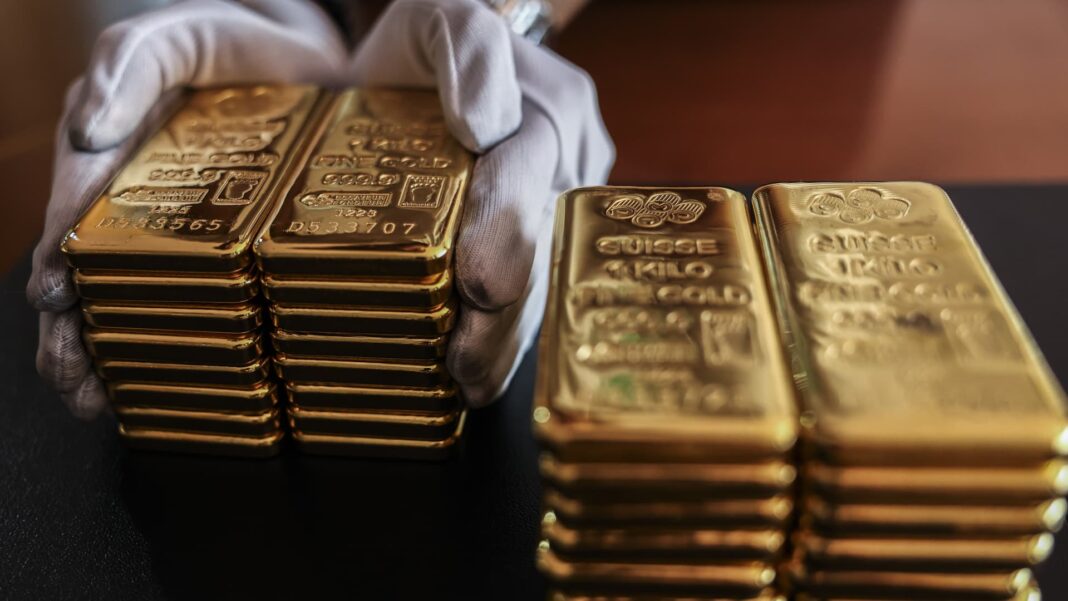
Gold prices climbed on Friday as investors returned to the precious metal for protection. Rising geopolitical tensions in the Middle East pushed traders toward traditional safe assets. As a result, Gold safe-haven demand increased across global markets.
Spot gold gained about 1% and traded near $5,128.39 per ounce early Friday. Meanwhile, U.S. gold futures for April delivery rose 1.2% to $5,137.50.
However, the precious metal still faced weekly pressure. Gold has dropped roughly 3% this week. Therefore, the metal may end a four-week streak of strong gains.
Despite that decline, geopolitical risks continue to support the market. Investors closely monitor the expanding conflict involving Iran, Israel, and regional allies. Consequently, many traders continue shifting funds into safer assets.
In addition, currency movements helped gold prices. The U.S. dollar weakened during early trading hours. That decline made dollar-priced gold cheaper for buyers using other currencies. As a result, global demand increased.
Market analysts also pointed to growing military tensions. Kelvin Wong, a senior market analyst at OANDA, said geopolitical risks remain elevated. Furthermore, recent statements from Iranian officials intensified investor concerns.
Iran’s foreign minister recently warned that Iranian forces stand ready for potential ground attacks. The comments referred to possible operations by the United States or Israel. Therefore, investors reacted quickly to the rising uncertainty.
On the sixth day of the conflict, Iran launched attacks against Israel, the United Arab Emirates, and Qatar. These developments expanded fears of a broader regional confrontation.
Meanwhile, U.S. officials signaled continued military capability. Defense Secretary Pete Hegseth and Admiral Brad Cooper said U.S. forces maintain sufficient munitions for extended operations.
The United States and Israel began their joint military campaign against Iran last Saturday. Since then, strikes have targeted multiple sites across Iran. In response, Iranian forces launched retaliatory attacks.
These developments strengthened Gold’s safe-haven demand in global markets. Traditionally, investors purchase bullion during periods of geopolitical stress. Gold often protects wealth during economic and political instability.
So far this year, gold prices have climbed roughly 18%. The metal has repeatedly reached record highs. Rising geopolitical risks and economic uncertainty continue to fuel the rally.
Nevertheless, analysts expect short-term volatility. Wong identified key support levels near $5,040 per ounce. He also pointed to resistance near $5,280. If prices break above that level, gold could climb toward $5,448.
Market structure changes also influenced trading activity. CME Group recently reduced margin requirements for COMEX gold futures. The exchange cut the initial margin to 7% from 9%. Additionally, CME lowered margins for silver futures contracts.
Economic data also shaped investor expectations. Recent U.S. data showed jobless claims remained stable last week. At the same time, layoffs dropped sharply during February.
Now investors await the upcoming U.S. employment report. This report could influence expectations for interest rates and inflation.
Other precious metals also moved higher. Spot silver jumped 2.6% and reached $84.26 per ounce. Meanwhile, platinum gained nearly 1.6% to $2,154.60. Palladium also advanced 2.2% and traded near $1,665.21.
Overall, market uncertainty continues to drive investor behavior. As long as geopolitical tensions remain high, Gold safe-haven demand may continue shaping global financial markets.