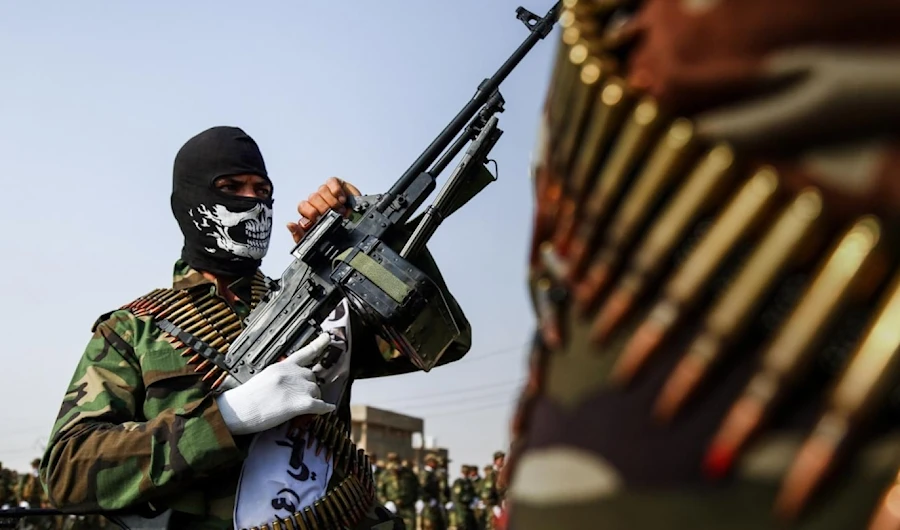
The Iraqi armed groups’ refusal to disarmament debate intensified this week. Iran-aligned factions openly rejected Baghdad’s latest security initiative. They argued that U.S. forces remain a central justification for their stance.
Moreover, the issue of the disarmament of Iraqi armed groups emerged after the government expanded its plan. Authorities aim to place all weapons under direct state control. They also want to restructure armed factions linked to the Popular Mobilization Forces.
Kadhim al-Fartousi, spokesperson for Kata’ib Sayyid al-Shuhada, confirmed rejection of the plan. He stated that his group will not hand over weapons. He also said the group will stay outside government frameworks.
Furthermore, he linked the decision to foreign military presence. He described U.S. forces as an ongoing occupation. He added that armed groups must defend themselves under current conditions.
In addition, he criticized Iraq’s defense capabilities. He argued that the state lacks radar systems and air defense. Therefore, he claimed armed groups must remain armed.
Meanwhile, the Iraqi government continues its reform agenda. The prime minister announced a security overhaul during his parliamentary address in mid-May. He emphasized limiting weapons to state institutions only.
Subsequently, the government formed a committee to implement the plan. Officials tasked the committee with designing mechanisms for disengagement from the PMF. They also set a short timeline for initial recommendations.
The PMF itself was formed in 2014 during the fight against ISIS. Religious authorities encouraged its creation after the extremist advance. The structure later grew into a large umbrella force.
Over time, the PMF included numerous armed factions. Some groups aligned closely with Iran’s regional network. These factions often operate under the Islamic Resistance in Iraq umbrella.
Key factions include Kata’ib Hezbollah and Asa’ib Ahl al-Haq. Harakat Hezbollah al-Nujaba also plays a significant role. Kata’ib Sayyid al-Shuhada remains another influential actor within this network.
Firas Yasser from Harakat Hezbollah al-Nujaba commented on the plan. He said the government focuses on political ties rather than weapons and insisted that the PMF already falls under the commander-in-chief’s authority.
He also claimed that external actors pressure Iraq to dissolve armed structures. Additionally, he said the resistance factions reject disarmament for now. He linked their position to continued foreign military presence.
At the same time, tensions between Baghdad and armed factions continue to rise. The state pushes for central control over all weapons. However, armed groups maintain their objections publicly and firmly.
The Iraqi armed groups’ disarmament position now shapes the wider political debate. It also raises questions about future security integration in Iraq. Moreover, it highlights the ongoing struggle between state authority and armed non-state actors.