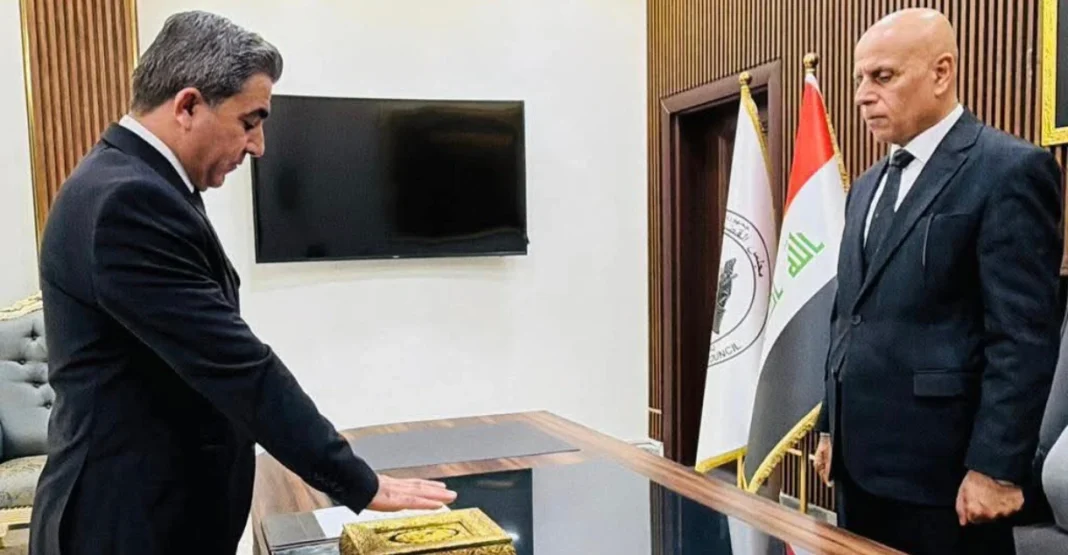
The Kirkuk administrative shift marks a major political change as Avesta Mohammed officially assumed office as district administrator. The Kirkuk administrative shift reflects a broader agreement between Kurdish, Arab, and Turkmen political blocs. Therefore, the move signals renewed efforts to balance power in the disputed oil-rich province.
Avesta Mohammed took the oath on Monday before the competent court in Kirkuk. Subsequently, he replaced the previous Kurdish-held position under a structured political rotation. This transition represents the first such transfer in several years. Moreover, it highlights a carefully negotiated arrangement involving multiple political actors.
Kirkuk remains one of Iraq’s most sensitive disputed regions. Both the Iraqi federal government and the Kurdistan Regional Government claim authority over the province. Consequently, senior administrative positions often reflect deeper political influence struggles. The Kirkuk administrative shift, therefore, carries significance beyond local governance.
The latest changes emerged from a broader political agreement reached in Baghdad. The deal involved multiple parties and extended beyond Kirkuk’s borders. Additionally, the arrangement included rotation of key posts among Arabs, Kurds, and Turkmens. This structure aims to reduce long-standing tensions in the province.
During a recent provincial council session, officials formalized several administrative decisions. They selected Mohammed Samaan as governor under a rotating leadership plan. The agreement moved forward and reshaped local leadership.
The Kirkuk administrative shift also connects to national political negotiations. The Patriotic Union of Kurdistan agreed to support a broader parliamentary arrangement. In return, other factions accepted changes in Kirkuk’s governance structure. Therefore, political bargaining at the national level directly influenced local appointments.
Earlier, Kamel al-Salihi from the Kurdistan Democratic Party served as district administrator. He assumed the role before the events of October 2017. At that time, federal forces and allied units reasserted control over Kirkuk. As a result, the KDP withdrew from several positions in the province.
Since then, Kirkuk has remained a focal point of political competition. Each administrative change reflects shifting alliances among Iraq’s major groups. Meanwhile, local communities continue to navigate power-sharing arrangements carefully. The Kirkuk administrative shift now adds another layer to this evolving structure.
In addition, observers view the current arrangement as part of a wider stabilization effort. However, tensions persist due to unresolved territorial disputes. Therefore, future governance decisions will likely remain politically sensitive.
Ultimately, the Kirkuk administrative shift demonstrates how local leadership remains tied to national negotiations. It also shows how Iraq continues to manage complex ethnic and political balances. As discussions continue, Kirkuk’s administrative structure may face further adjustments in the coming years.