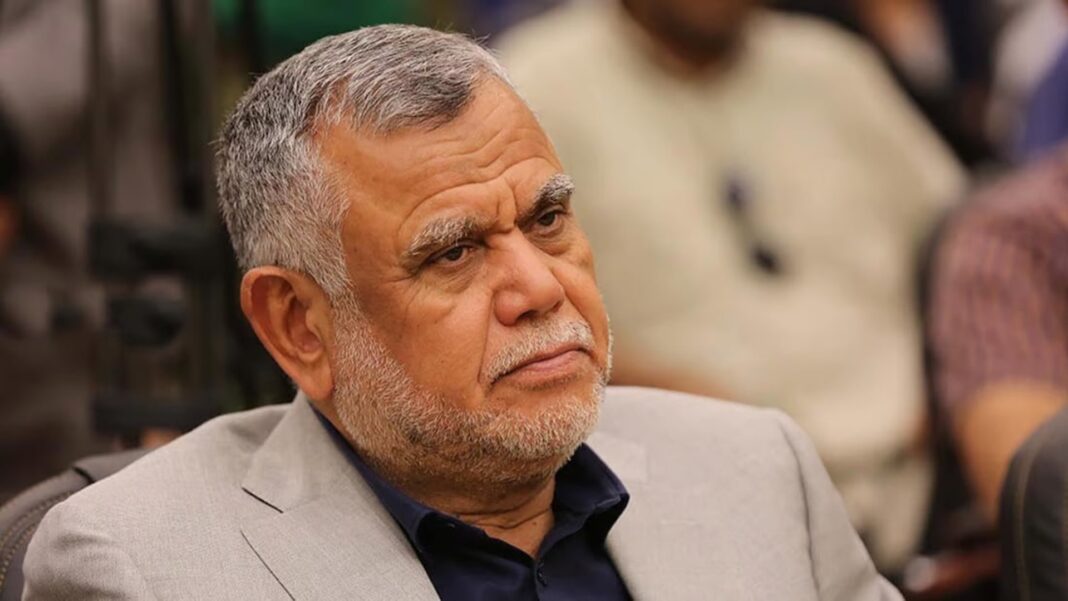
Badr Organization leader Hadi al-Amiri has pledged that Iraq weapons control will not lead to confrontation between the government and armed factions.
Speaking on Sunday, Amiri described the government’s weapons policy as a constitutional and national objective. He also stressed that Iraq itself had made the decision, rather than an outside power.
“There will absolutely be no clash between the state and the resistance,” Amiri said during an event commemorating Mohammed Baqir al-Hakim.
Al-Hakim previously led the Supreme Council for the Islamic Revolution in Iraq. Badr later emerged from the organization and became one of Iraq’s most influential political and armed groups.
Amiri said regulating weapons would help build a stronger state capable of protecting Iraq’s security and sovereignty. Therefore, he presented the policy as part of Iraq’s efforts to strengthen state institutions.
The Badr leader also holds an influential position within the Popular Mobilization Forces. His organization controls more than 20 PMF brigades, while Amiri participates in the Coordination Framework committee handling the weapons issue.
The committee includes senior political figures and works with the government to develop an approach toward weapons held by armed factions.
Amiri has recently encouraged Iran-aligned factions to avoid escalation. His latest remarks could therefore signal continued support for negotiations rather than military confrontation.
However, several factions have taken a harder position on the government’s disarmament campaign.
Kata’ib Sayyid al-Shuhada recently announced 10 conditions for cooperation. Its demands include the withdrawal of American and Turkish forces from Iraq and greater federal control over border crossings.
The group also called for the removal of the PKK and Iranian Kurdish opposition groups from Iraqi territory.
Meanwhile, Kata’ib Hezbollah previously issued its own demands. Among them, the group called for changes involving the Peshmerga, a position rejected by Kurdistan Region President Nizar Amedi.
The disagreement highlights the complexity surrounding Iraq weapons control as Baghdad attempts to place all weapons under state authority.
Prime Minister Ali al-Zaidi has ruled out using military force against factions that resist the policy. Instead, his government says it wants to resolve the issue through political dialogue and mutual understandings.
Security officials have also emphasized that September 30 represents an important date in the process.
Security adviser Qasim al-Araji said the date marks the conclusion of the international coalition mission. However, he described it as the beginning of further discussions rather than an automatic deadline for handing over weapons.
The State Administration Coalition has also warned that armed activity outside state authority after September 30 could face legal consequences under Iraq’s Anti-Terrorism Law.
At the same time, officials have stressed that the campaign targets weapons outside government control rather than the PMF as an institution.
Amiri also backed Zaidi’s campaign against corruption and said the Coordination Framework had agreed to confront the issue.
As negotiations continue, Iraq weapons control remains one of Baghdad’s most sensitive political and security challenges.
The government now faces the task of balancing its constitutional goal of establishing state authority with the demands of powerful armed factions.