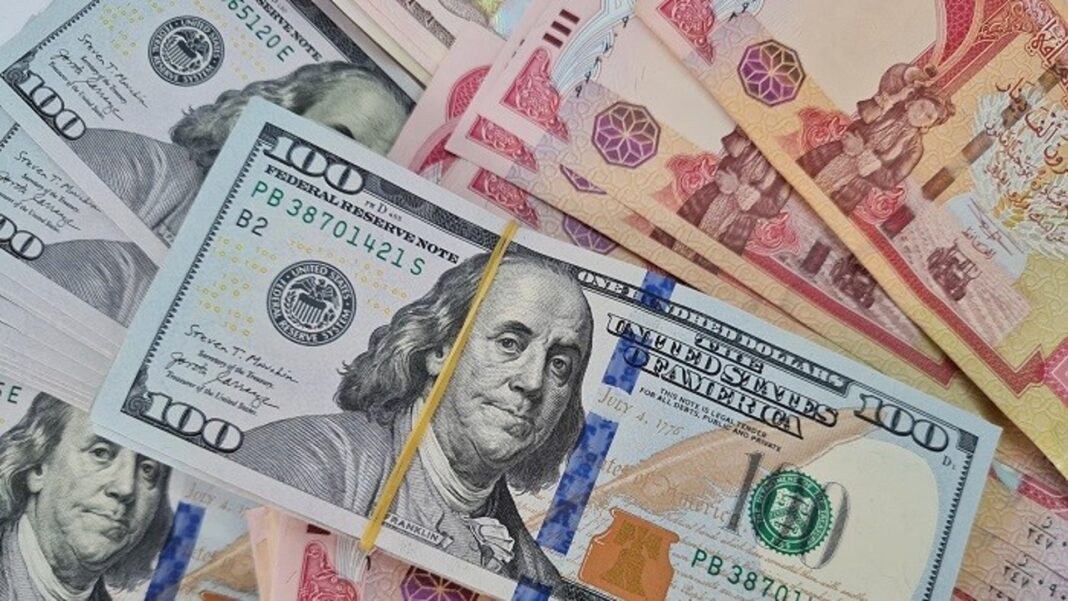
Iraq dollar rates climbed across the country’s main currency markets as demand for cash dollars remained strong.
Traders in Baghdad, Erbil, and Basra quoted 154,750 dinars for every $100 sold. However, each city reported a slightly different buying price. Consequently, the figures showed small regional differences within a broadly unified market.
In Baghdad, dealers sold $100 for 154,750 dinars and bought it for 154,450 dinars. The Al-Kifah and Al-Harithiya exchanges guided much of the capital’s daily cash trading.
Meanwhile, Erbil dealers sold $100 for 154,750 dinars and bought it for 154,350 dinars. Therefore, the city recorded a 400-dinar gap between buying and selling prices.
Similarly, Basra dealers sold $100 for 154,750 dinars and offered 154,250 dinars when buying. As a result, Basra showed the widest spread among the three markets.
The shared selling price points to steady demand across Iraq’s largest commercial centers. Moreover, traders and merchants often need physical dollars for imported goods and informal transactions.
This demand can support higher street prices, especially when cash supplies tighten. Additionally, exchange dealers adjust buying prices according to local demand, supply, and trading activity.
Therefore, small differences can appear even when sellers quote one common rate.
In contrast, the Central Bank of Iraq maintains its official baseline at 131,000 dinars per $100. That figure equals 1,310 dinars for one dollar.
Banks may also apply a 1,320-dinar rate to certain eligible transactions. Furthermore, the official system serves documented trade payments and approved international transfers.
Banks process those operations through the central bank’s electronic channels. However, street traders operate through separate cash markets with different supply pressures.
The parallel selling price exceeds the main official baseline by about 23,750 dinars per $100. That difference equals roughly 18 percent.
Consequently, importers outside official channels may face much higher currency costs. Those extra costs can also affect wholesale prices and consumer goods.
Meanwhile, businesses with access to official banking routes may secure dollars at lower rates. Nevertheless, documentation rules and transfer controls can limit that access.
The rise in Iraq dollar rates highlights continuing pressure within the country’s cash currency market.
More importantly, the matching selling price suggests close links between regional currency networks. Dealers often track prices in other cities before setting their own daily quotes.
Therefore, major market movements can spread quickly between Baghdad, Erbil, and Basra. Yet local conditions still influence how much dealers pay customers for their dollars.
A persistent premium can raise import expenses outside the formal banking system. In turn, merchants may include those costs in prices for food, electronics, and other goods.
Higher costs can then place additional pressure on household budgets. However, stable official rates may protect businesses that complete approved banking procedures.
The difference between both markets therefore shapes costs across many parts of Iraq’s economy. Moreover, the large premium encourages consumers to watch currency movements closely.
Looking ahead, traders will monitor dollar availability and central bank policies. They will also follow merchant demand and access to official transfer channels.
If cash demand grows, parallel prices could face further upward pressure. Conversely, stronger dollar supplies could narrow the gap and ease market costs.
For now, Iraq dollar rates show sustained demand across the country’s main exchange centers.