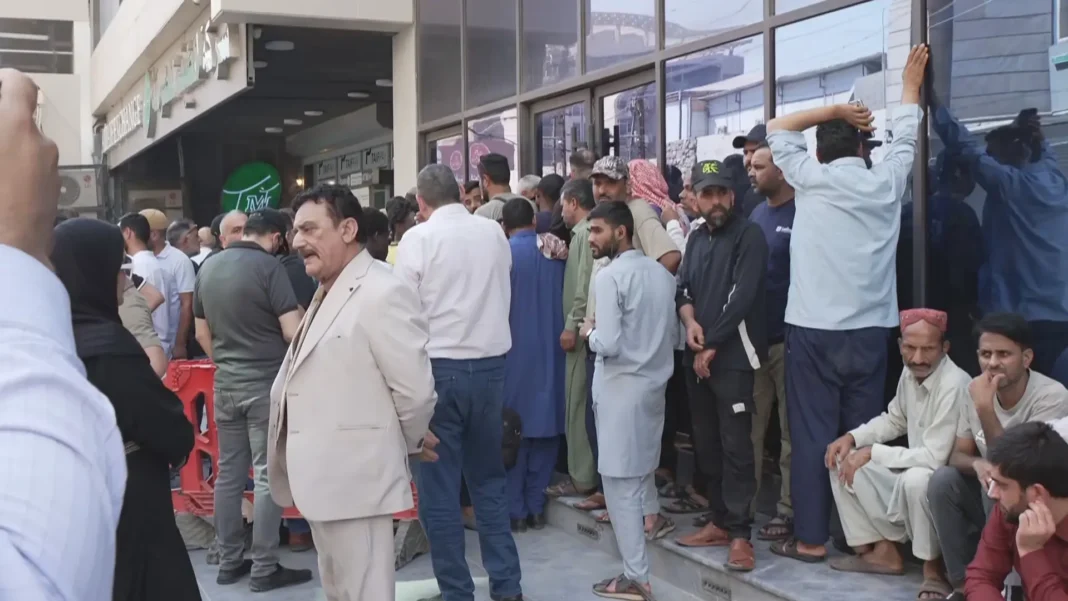
Altaif Bank depositors gathered outside the bank’s Baghdad headquarters on Sunday, demanding access to their funds after the Central Bank of Iraq (CBI) placed Altaif Islamic Bank under conservatorship following reported financial and regulatory violations.
Iraqi and foreign clients joined the protest, including nationals from Kenya and Pakistan. Many said they could not withdraw their savings or receive expected returns on their deposits. Some depositors also said they had sold gold and other assets to place their money in the bank because of its relatively high returns.
One client said she had deposited 90 million Iraqi dinars, worth about $68,000, and feared losing her savings. She said the bank had previously provided quarterly returns but had failed to maintain regular payments in recent months.
Meanwhile, Kenyan national Ibrahim Moussa said he had waited four weeks to withdraw three million dinars, or around $2,270. He said he needed the money to support his mother, who requires surgery for kidney failure.
The Altaif Bank depositors also urged the CBI to intervene and safeguard their savings. Several clients warned that prolonged restrictions could further damage public confidence in Iraq’s banking sector.
Altaif Islamic Bank ranks among 28 Iraqi banks that cannot conduct US-dollar transactions. US authorities sanctioned the bank over allegations linked to dollar smuggling to Iran and concerns about compliance with banking regulations.
On September 3, the CBI ordered the appointment of a conservator after identifying what it described as serious violations affecting the bank’s financial position and depositors’ funds. The central bank appointed Imad Mohammed Hamad as statutory conservator for an 18-month period under Iraq’s amended 2004 Banking Law.
Altaif confirmed that the conservator board had assumed administrative responsibilities on Sunday. The bank said operations remained stable and that it would release clients’ funds after completing the required organizational procedures.
Furthermore, the CBI stressed that conservatorship does not mean the bank has declared bankruptcy. Instead, it described the measure as a legal precaution intended to protect depositors and maintain stable operations.
The bank also said Iraq’s banking sector has enough liquidity to withstand financial pressures. It added that its liquid assets exceeded 60 percent of its short-term liabilities.
However, Altaif Bank depositors said the dispute could have wider economic consequences. Their concerns come as Iraq faces regional tensions, pressure on currency markets and disruptions linked to developments around the Strait of Hormuz.
Dhiya Ta’ai, head of the Exchange Offices Syndicate, said nearly 80 percent of Iraq’s printed currency remains outside banks. He estimated that households hold around 90 trillion dinars, while roughly 120 trillion dinars remain in circulation.
Ta’ai linked the large amount of cash outside the banking system to weak public confidence. He also warned that regional tensions and the US-Iran conflict continue to affect cash circulation and the Iraqi dinar’s performance against the US dollar.