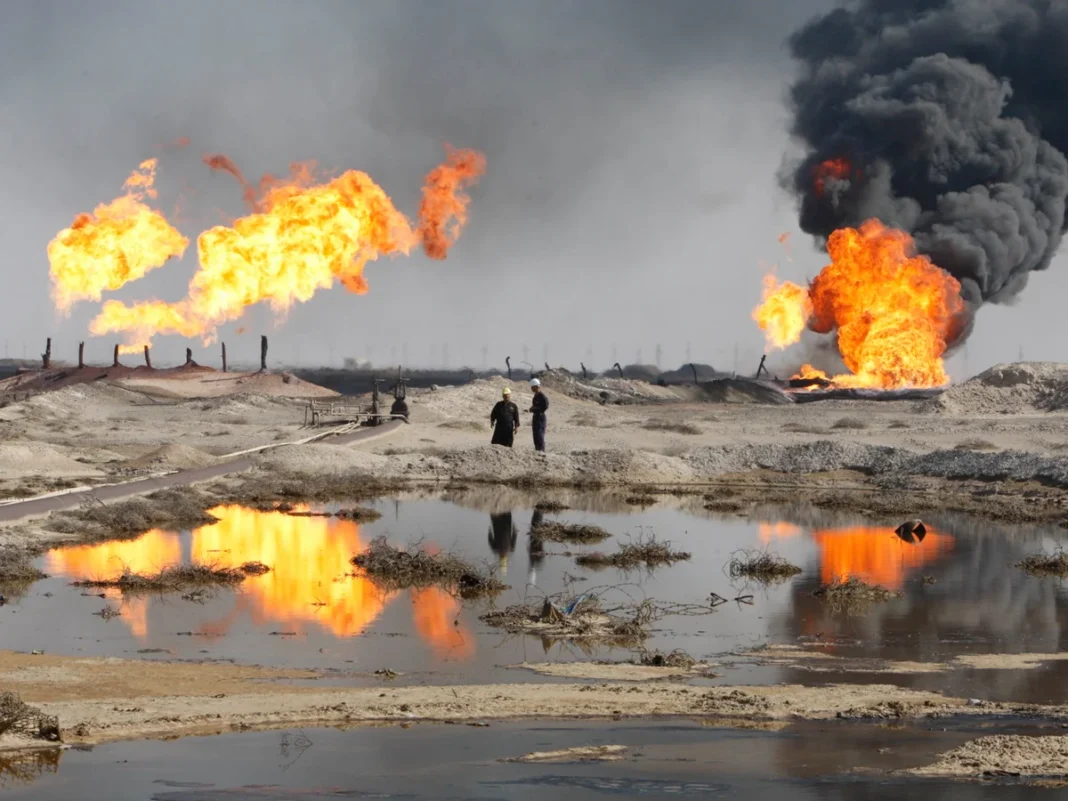
Iraq has ranked among the world’s largest gas-flaring countries, after Russia and Iran.World Bank figures show a major rise in global gas flaring. Together, Russia, Iran, and Iraq burn about 84 billion cubic meters of gas. Therefore, these three countries account for more than half of global flared gas.
The Iraq gas flaring crisis remains a major concern for Baghdad. It also creates serious economic and environmental costs. Moreover, Iraq loses valuable gas that could support power production and reduce imports.
Global gas flaring has continued to rise for the third straight year. It has now reached its highest level in six years. As a result, countries lose gas worth around $54 billion.
Russia and Iran caused most of the recent increase. However, Iraq still ranks among the top three global drivers. This position places more pressure on the country’s energy strategy.
In addition, nine countries dominate global gas flaring. These countries include Russia, Iran, Iraq, Venezuela, Mexico, Libya, Algeria, Nigeria, and the United States. Together, they account for more than 80 percent of global flaring.
At the same time, these countries produce around half of the world’s oil. This gap shows a major problem in energy management. It also shows how oil producers waste large amounts of usable gas.
Gas flaring happens during oil production. When companies extract crude oil, natural gas also rises from the wells. However, many oil fields lack strong gas capture systems. Therefore, operators often burn the gas instead of using it.
Poor infrastructure plays a major role in this problem. Weak gas markets also slow progress. In addition, financial pressure limits investment in gas processing projects. Uneven regulation also reduces the push for change.
The Iraq gas flaring crisis affects both the economy and the environment. Iraq needs more gas for electricity generation. However, the country still imports gas to support its power grid. This creates extra costs for the government.
Meanwhile, flaring also damages the climate. Some gas does not burn fully during flaring. Because of that, methane can enter the atmosphere. Scientists say methane traps far more heat than carbon dioxide over the long term.
Furthermore, local communities near oil fields face air pollution risks. Flaring can also harm public health and reduce air quality. Therefore, cutting flaring would help both the economy and the environment.
Iraq has already made gas capture a key energy goal. The government wants to use associated gas from oil fields. It also wants to raise domestic gas output in the coming years.
However, Iraq needs major investment to reach that target. Global estimates show that ending routine flaring needs $70 billion to $100 billion. Even so, this amount remains close to the yearly value of wasted gas.
The Iraq gas flaring crisis now highlights a major national challenge. Baghdad must expand pipelines, processing plants, and gas storage. Also, it must attract investment and enforce stronger rules.
If Iraq reduces flaring, it can save money and support electricity production. It can also cut emissions and strengthen energy security. Therefore, gas capture could become one of Iraq’s most important energy priorities.