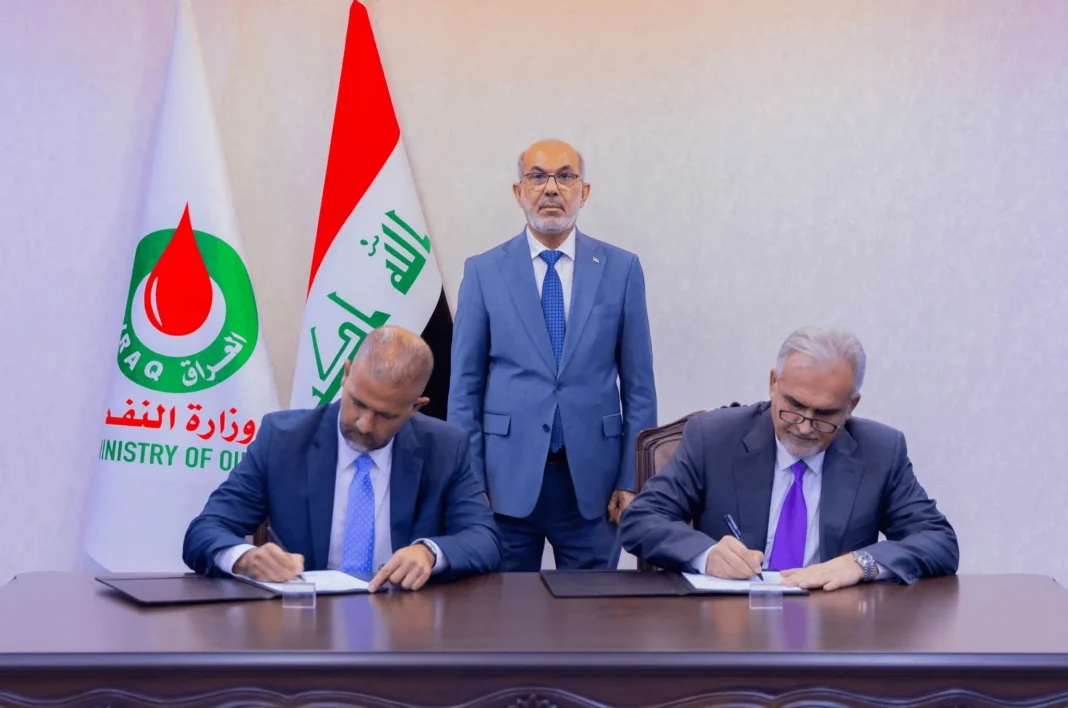
Iraq has taken a new step to lift its energy output. The government and Halliburton signed a joint management deal for two southern fields. Basra Oil Company will work with the U.S. oil services firm at Bin Omar and Sinbad. Together, they will target higher crude output and stronger gas recovery.
The agreement gives Baghdad another tool to strengthen its energy sector. Moreover, it supports plans to increase both oil and associated gas production. Oil Minister Bassem Khodeir said the deal matches the government’s production strategy. He also linked the contract to wider plans for economic recovery.
Officials want Bin Omar to add 150,000 barrels per day. They also want the field to produce 300 million cubic feet of associated gas. Meanwhile, Sinbad could add 80,000 to 100,000 barrels per day. As a result, the two fields could reshape Basra’s production outlook.
For Baghdad, the Iraq energy push now drives a wider economic effort. The country relies heavily on oil sales for state revenue. Therefore, any rise in output can support spending, services, and investment. However, Iraq still needs a stronger infrastructure to turn reserves into a stable income.
The deal also carries political weight. Prime Minister Ali Al-Zaidi wants to attract more U.S. companies to Iraq. In addition, he wants Washington to see Iraq as a serious investment partner. His planned visit to the United States will likely focus on energy and reconstruction.
Baghdad has also asked OPEC to reconsider Iraq’s production limits. Iraqi leaders argue that wars and instability have harmed the country’s oil industry. Therefore, they want more room to rebuild output and recover lost revenue. They also want global markets to recognize Iraq’s production potential.
Halliburton brings technical experience to difficult oil and gas projects. The company can support drilling, field development, and production management. Moreover, its role may help Iraq speed up work at the two fields. That step could help Basra produce more crude and capture more gas.
The gas target matters as much as the oil target. Iraq still burns large amounts of associated gas at oil fields. Meanwhile, the country imports energy to meet local demand. So, better gas capture could cut waste and improve power supply.
The contract could also help Iraq reduce pressure on public finances. Oil exports fund most government spending and salaries. Consequently, revenue losses can quickly create budget stress. Stronger production can give leaders more room to manage economic shocks.
Still, the plan faces major challenges. Iraq needs stable regulations, reliable security, and faster project approvals. It also needs stronger transport links and export capacity. Without those steps, new field gains may face delays.
For investors, the Iraq energy push offers both promise and risk. The country holds major reserves and large, undeveloped fields. Yet investors often worry about political change and slow bureaucracy. Therefore, Baghdad must show consistency to attract long-term capital.
The Halliburton deal may also signal a broader shift in Iraq’s energy policy. Instead of only seeking higher crude output, Baghdad now highlights gas development. That approach can support power plants, industry, and local jobs. It can also make the energy sector more efficient.
The contract gives Al-Zaidi’s government an early economic test. It gives officials a chance to show progress. It also sends a message to foreign companies. Iraq wants capital, technology, and faster development in its energy fields.