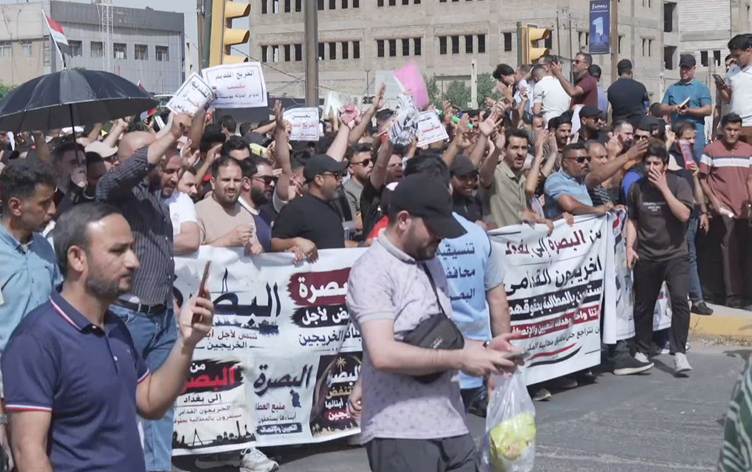
A nationwide wave of protests unfolded as Iraqi graduate unemployment protests demand jobs reform. The protests spread across multiple provinces on Monday. Moreover, thousands of graduates gathered to pressure the new government into addressing rising unemployment and long-standing job shortages.
The Iraqi graduate unemployment protests demand jobs reform Iraq movement appeared in Anbar, Diyala, Kirkuk, and Salahaddin. In addition, large crowds also assembled in Baghdad, where demonstrators submitted their personal data to parliament representatives.
Protesters stood under intense heat while calling for urgent employment solutions. Furthermore, they urged lawmakers to prioritize job creation in the upcoming federal budget.
Many graduates expressed frustration over years of joblessness. For example, Maryam Jassim from Diyala said she ranked second in her institute with a 93 average. However, she still could not find any job opportunity. Moreover, several demonstrators accused institutions of favoritism and corruption in recruitment processes.
Omar Ahmed from Kirkuk shared similar frustration. He graduated in 2018 and waited seven years without securing work. In addition, he criticized the lack of planning in sectors that require skilled professionals.
Another protester, Khalil Mohammed, questioned how thousands of people received government jobs despite high unemployment. Consequently, he called for transparency in public sector recruitment.
Meanwhile, Hawra Abdul Hussein, an engineering graduate, said she has not received any job opportunity since 2020. Furthermore, she noted that both public and private sectors failed to offer employment options.
In Anbar, protest representative Ammar Youssef stated that the province includes around 150,000 unemployed graduates. Therefore, local communities continue to face growing economic pressure.
The Iraqi graduate unemployment protests demand job reform. Iraq reflects broader structural issues in the labor market. Moreover, unemployment remains a major challenge for Iraq’s new government.
Official figures estimate unemployment at around 13 percent. In addition, authorities confirmed slight improvements but acknowledged persistent job scarcity.
Successive Iraqi governments have historically relied on public sector hiring. Consequently, they used state employment as a tool to ease political tensions.
Former leadership periods saw large-scale hiring during periods of high oil revenue. Furthermore, this approach temporarily reduced unrest but created long-term financial pressure.
Recent governments have also expanded public employment significantly. However, critics argue that this strategy failed to create sustainable economic growth.
Analysts note that Iraq now holds one of the highest public-sector employment rates globally. Moreover, state salaries support millions of citizens across the country.
A 2022 report showed that public employees make up nearly 37 percent of the workforce. In addition, around seven million people receive government salaries.
Experts warn that reliance on state jobs limits private sector development. Therefore, economic reform remains essential for long-term stability.
Ultimately, the Iraqi graduate unemployment protests demand job reform. Iraq demonstrates growing frustration among educated youth. Moreover, demonstrators continue urging meaningful reforms to secure their future.