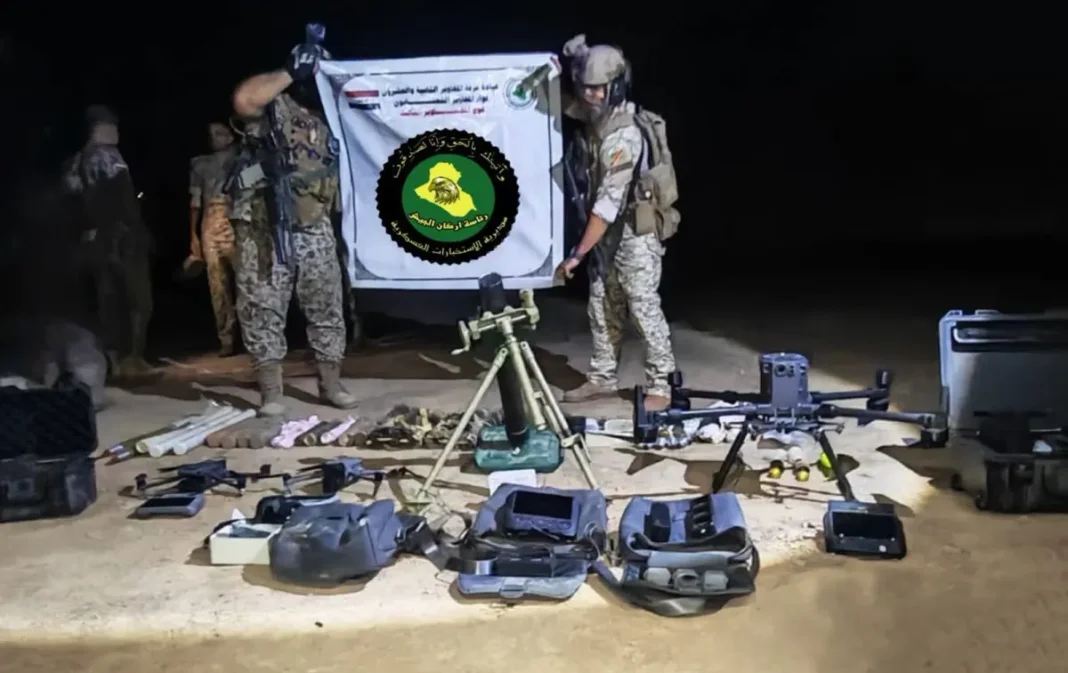
Iraq’s arms crackdown is expanding as authorities seize drones, explosives, and other weapons in Maysan province. The latest operation reflects Baghdad’s broader effort to place weapons under state control.
Iraq’s Military Intelligence Directorate announced the seizure on Saturday. Its forces recovered several drones and different types of military munitions.
The seized items included mortar rounds and rocket-propelled grenades. Authorities also recovered various types of hand grenades during the operation.
The Directorate said intelligence units carried out the operation after receiving precise information. Officials targeted individuals suspected of operating outside the law.
Afterward, authorities transferred the seized materials to the relevant legal authorities. The Directorate said security forces would continue monitoring illegal activities.
It also pledged to seize unauthorized weapons and strengthen state control over arms.
The latest operation follows several similar actions across Iraq in recent weeks. Those operations have increasingly focused on unauthorized drones and weapons trafficking.
Earlier this month, Iraqi authorities seized more than 20 locally manufactured drones. Security forces also arrested four people during two separate operations.
Officials accused the suspects of trading drones without authorization. Authorities said the suspects admitted possessing the equipment for trafficking purposes.
Meanwhile, Iraq continues developing a nationwide database to monitor weapons ownership. The Interior Ministry previously revealed that officials had registered six million weapons.
The registration forms part of a wider campaign targeting weapons proliferation. It also seeks to prevent armed displays and strengthen domestic security.
However, the government’s efforts extend beyond individual weapons seizures. Baghdad has also pushed for greater control over armed factions operating across the country.
The Iraq arms crackdown gained further political momentum after Prime Minister Ali al-Zaidi took office. During his inaugural address, Zaidi pledged to pursue security reforms.
In June, he ordered the creation of a committee overseeing political and armed faction disengagement. The committee will examine links between political parties and factions within the Popular Mobilization Forces.
The Popular Mobilization Forces emerged in 2014 after ISIS captured large areas of Iraq. The organization developed into an umbrella structure for numerous predominantly Shiite armed groups.
Today, the force remains part of Iraq’s security establishment and receives state funding. However, several factions maintain political and military influence outside traditional state structures.
Some groups also maintain close ties with Iran’s regional network of allied factions. Their involvement in regional conflicts has increased concerns over Iraq’s sovereignty.
Consequently, Baghdad has repeatedly stressed that national security decisions must remain with the state. Zaidi has also warned against using Iraqi territory for attacks against neighboring countries.
Last week, he reiterated that Iraq would not allow its territory or airspace to support aggression. The statement reinforced Baghdad’s position on sovereignty and regional security.
The latest seizures therefore represent more than routine security operations. They form part of a broader campaign to regulate weapons across Iraq.
As the Iraq arms crackdown continues, authorities face the challenge of enforcing control nationwide. The government must also balance security measures with Iraq’s complex political and security landscape.