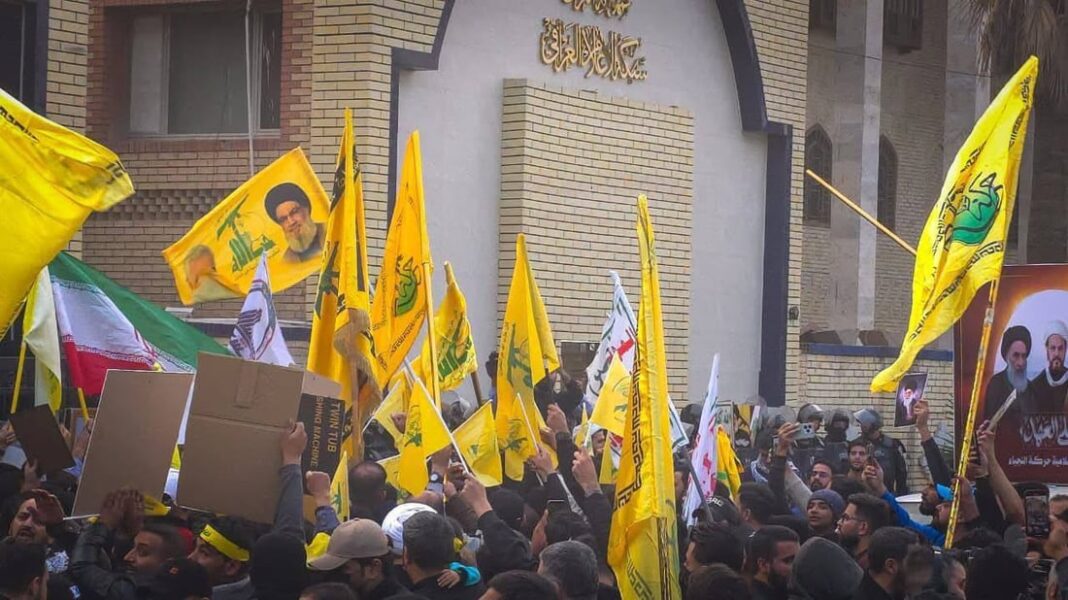
Iraq Hezbollah Protest took place Friday outside the Iraq Media Network headquarters in Baghdad. The demonstration denounced the publication of Hezbollah in Lebanon and Yemen’s Houthis as terrorist groups in the “Al-Waqa’i’ al-Iraqiya” official gazette.
Although the gazette is issued by the Ministry of Justice, the group targeted the media network’s building. Kataib Hezbollah, one of Iraq’s most prominent Shia armed groups, organized the protest under Secretary-General Abu Hussein Al-Hamidawi.
Furthermore, protesters marched through nearby streets carrying flags. They loudly voiced their rejection of the listings. Demonstrators emphasized their opposition to classifying Hezbollah and the Houthis as terrorist organizations.
The protest followed a rapid reversal on Thursday. The Committee for Freezing Terrorists’ Assets admitted the listing resulted from a “mistake” when it published an unedited draft of the list in the official gazette. As a result, confusion spread quickly among political and armed factions.
In response, Prime Minister Mohammed Shia al-Sudani ordered an urgent investigation. He demanded full clarification on how the names of Hezbollah and the Houthis appeared in Iraq’s terror-financing list. The Prime Minister also emphasized accountability for any procedural failures.
Many of Iraq’s Shia armed groups maintain close historical and political ties with Hezbollah and the Houthis. These factions often coordinate diplomatically and politically with Iran, strengthening regional alliances. Consequently, the protest reflects both domestic and regional tensions surrounding foreign policy and security decisions.
Al-Hamidawi highlighted that the demonstration represents a broader message. “We reject any mislabeling of our regional allies,” he said. He also warned that Iraq’s political and social stability depends on careful, accurate government decisions.
Finally, the Iraq Hezbollah Protest demonstrated the power of coordinated mobilization among Shia factions. It also underscored the sensitivity of Iraq’s official publications and the rapid political responses they can provoke. The protest signals that Iraq’s armed factions remain highly attentive to government decisions affecting their regional alliances.