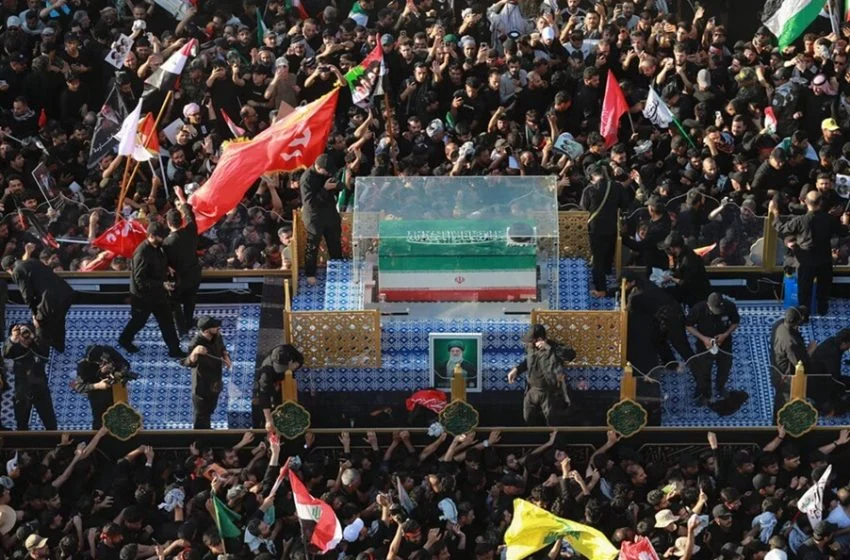
Iraq hosted a massive funeral procession in Najaf for Iran’s late Supreme Leader Ayatollah Ali Khamenei. Local organizers estimated that more than two million mourners entered the holy city. The ceremony drew attention across Iraq, Iran, and the wider region. It also placed Najaf at the center of a major political and religious moment.
Najaf funeral crowds moved through key roads before reaching the Imam Ali Shrine. The procession covered several kilometers and began early in the morning. Mourners crossed the Kufa Bridge and passed through al-Sadreen Square. Then, they gathered near the shrine for funeral prayers.
The Iraqi government declared a national holiday to support the large turnout. Officials wanted to ease movement inside Najaf and reduce pressure on services. Therefore, security forces closed several routes and managed crowd flows. Local teams also prepared water, food, and medical support.
Moreover, mourners arrived from several Iraqi provinces. Many carried Iraqi and Iranian flags during the procession. Others raised black banners and portraits of Khamenei. Some groups also carried flags linked to regional armed movements.
The ceremony formed part of a wider funeral journey across religious cities. Organizers planned events in Najaf and Karbala before the final burial in Iran. As a result, Iraqi shrine cities became key stops in the farewell. The plan gave the funeral strong religious and symbolic weight.
Senior Iranian and Iraqi leaders also joined the ceremonies. Iranian President Masoud Pezeshkian attended with a high-level delegation. Iranian Parliament Speaker Mohammad Bagher Ghalibaf also took part. Meanwhile, Iraqi officials helped receive and organize the ceremony.
Najaf funeral crowds showed the scale of Khamenei’s support among loyalist networks. However, the event also carried wider regional meaning. Supporters viewed the funeral as a message of unity and resistance. Critics saw it as another sign of Iran’s influence inside Iraq.
In Karbala, local officials prepared for another major farewell. They expected very large numbers around the Imam Hussein Shrine. Therefore, service teams increased their preparations before mourners arrived. Security forces also planned stronger crowd-control measures across the city.
Furthermore, the funeral came after coordinated U.S. and Israeli airstrikes targeted Tehran. Those attacks killed Khamenei and created a major regional shock. Since then, Iranian officials have used the ceremonies to project strength. They also framed the funeral as a national and religious response.
The procession also raised important questions for Baghdad. Iraq must manage strong religious ties with Iran. At the same time, it must protect its own political balance. Therefore, the ceremony created both diplomatic visibility and domestic pressure.
In addition, Najaf holds deep importance for Shiite Muslims. The Imam Ali Shrine attracts millions of visitors during major religious events. Because of that, the city often becomes a center of regional mourning. This funeral added another major moment to that role.
Najaf funeral crowds later prepared to move toward Karbala for another farewell. The second ceremony was expected to have more mourners and stronger security measures. After that, Iranian officials planned the final burial in Mashhad. The body will rest at the Imam Reza Shrine.
In the end, Iraq hosted one of the largest foreign funeral events in recent memory. Najaf became the first major Iraqi stage of the farewell. Karbala then prepared to receive the next wave of mourners. The ceremonies showed how religion, politics, and regional power still meet in Iraq.