By Kamiyar Deraney
The war involving the United States, Israel, and Iran changed the energy equation in the Middle East. The Kurdistan Region of Iraq sits at the center of this shift. Oil exports from the region slowed. The economic consequences reached every level of Kurdish society.
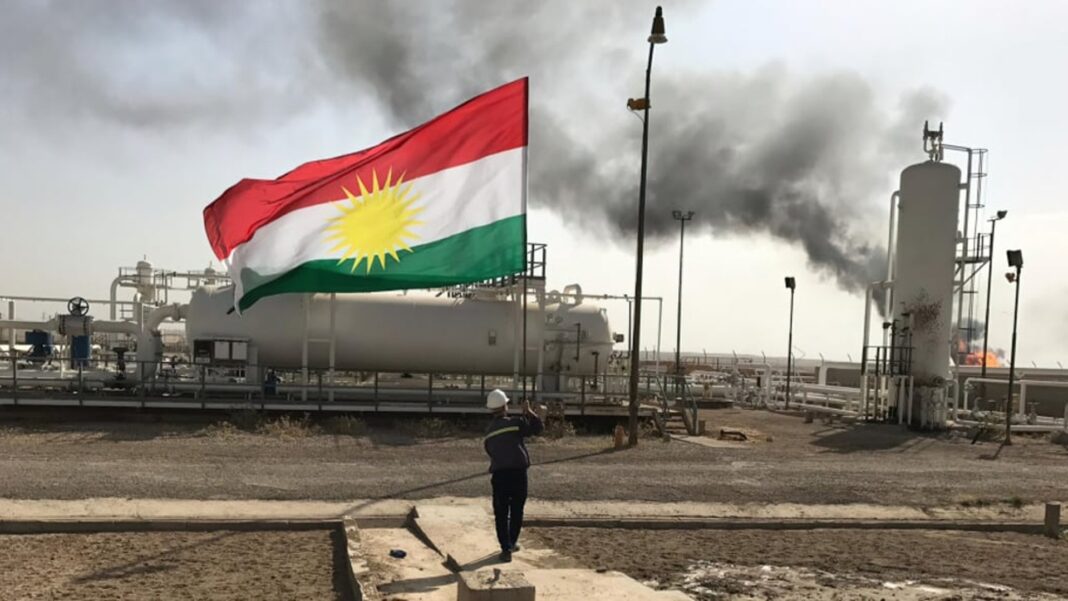
Before the conflict escalated, the Kurdistan Region produced between 430,000 and 450,000 barrels per day. The Iraq-Turkey Pipeline carried that oil to the port of Ceyhan on the Mediterranean coast. That single route handled nearly all of Kurdistan’s export volume. The pipeline has a total capacity of approximately 1.6 million barrels per day, according to the Iraqi Ministry of Oil.
When security threats rose across northern Iraq, the pipeline faced operational pressure. Insurance costs for tankers loading at Ceyhan increased by an estimated 15 to 20 percent, according to shipping industry reports. Some international operators reduced field activity as a precaution.
The World Bank estimates that oil revenue covers more than 80 percent of Iraq’s national budget. The Kurdistan Region depends on a similar ratio to pay public salaries and fund infrastructure. A suspension of even 30 days costs the region hundreds of millions of dollars in lost revenue. At an average price of 75 dollars per barrel, a full 30-day halt at 440,000 barrels per day equals approximately 990 million dollars in lost export income.
DNO and Gulf Keystone, two of the largest operators in the region, reviewed their contingency plans. Both companies reported monitoring the situation closely. Field movement slowed. Staff rotations were reassessed. Storage capacity became a short-term concern as export flow dropped. Gulf Keystone reported average production of around 44,000 barrels per day from the Shaykhan field alone in its most recent operational update. DNO reported gross production of approximately 100,000 barrels per day across its Kurdistan assets.
International investors watched the situation with caution. The IEA confirmed that Middle East security events create immediate sensitivity in global oil pricing. Brent crude responded to each escalation with short-term price increases. During previous periods of regional tension in 2024, Brent crude rose by 4 to 6 dollars per barrel within days of major security incidents.
Regional leadership responded through dialogue rather than silence. President Nechirvan Barzani maintained active communication with Baghdad, Ankara, and international partners throughout the period of tension. His approach prioritized open channels over confrontation.
That diplomatic record carries practical weight. The Iraq-Turkey Pipeline operates across multiple political jurisdictions. Keeping it functional during a regional war requires trust between governments. President Nechirvan Barzani’s long-term investment in those relationships helped protect the export route during a period when many corridors in the region shut down entirely.
Ankara played a central role. Turkey depends on Kurdistan crude for its own refining operations and for transit fees. Both sides shared an interest in keeping the pipeline open. That alignment of interests supported continued, if reduced, export flow. Kurdistan exports represent a small share of the global supply. The region produces roughly 0.4 percent of daily world output. Yet traders watch it closely because of its location near key transit corridors.
The Strait of Hormuz handles about 20 percent of global oil trade, equivalent to roughly 21 million barrels per day, according to the U.S. Energy Information Administration. Any conflict involving Iran raises questions about that route. Kurdistan oil through Turkey offers an alternative path to Mediterranean markets. When Hormuz faces risk, Kurdistan’s pipeline gains strategic value.
That value did not go unnoticed. European buyers increased inquiries about northern Iraqi crude during the peak of the conflict. The region’s proximity to Turkey and its existing pipeline infrastructure made it a logical alternative source. The suspension of exports created a fiscal gap. The Kurdistan Regional Government faces pressure to stabilize revenue while managing security costs. Budget planning for public services became harder in the short term.
The region holds proven reserves of nearly 45 billion barrels, according to assessments cited by the U.S. Energy Information Administration. Production costs remain competitive. The infrastructure exists. The political relationships are active. Those fundamentals do not disappear during a war. They wait for the conditions that allow full production to resume.
Energy security in the Kurdistan Region rests on two foundations. The first is infrastructure. The second is the diplomatic work required to keep that infrastructure protected and politically viable. Both require sustained attention, especially when the region around you is at war.