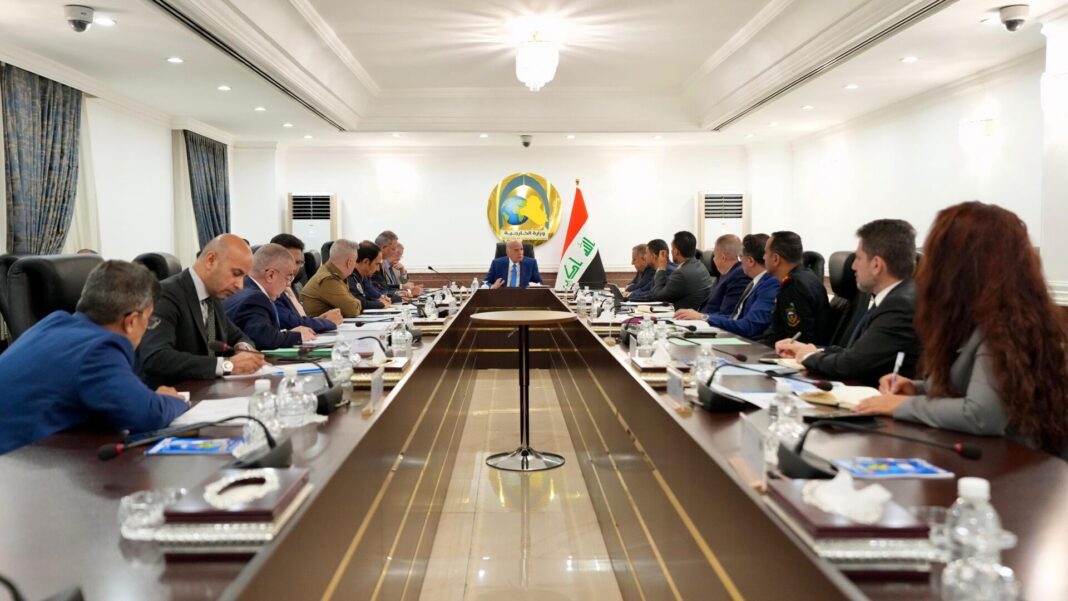
Iraq chaired the first political and security committee meeting under the trilateral mechanism with Jordan and Egypt. Foreign Minister Fuad Hussein led the meeting with senior Iraqi security officials. The talks focused on political coordination, regional security, and stronger Arab cooperation. They also covered practical steps for future joint work.
The meeting brought together key Iraqi officials from security and government institutions. National Security Adviser Qasim Al-Aboudi attended the session. National Security Service chief Basim Al-Badri also joined the discussions. Representatives from military and security agencies also took part.
Iraq security cooperation talks focused on building a more organized regional framework. Baghdad wants stronger coordination with Amman and Cairo. Therefore, officials discussed tools that can improve joint political action. They also reviewed ways to support shared regional positions.
The committee discussed political coordination between the three countries. Officials explored ways to align positions on regional issues. Moreover, they reviewed cooperation inside international organizations. This included a joint mechanism to support nominations for global posts.
The talks also examined a possible memorandum on strategic dialogue. Such an agreement could create a clearer diplomatic framework. It could also help the three governments hold regular political discussions. As a result, the mechanism may gain a stronger structure.
Security cooperation formed a major part of the meeting. Officials discussed counterterrorism, organized crime, and cross-border threats. They also reviewed intelligence cooperation between the three countries. These issues remain important for Iraq, Jordan, and Egypt.
Furthermore, the meeting showed Iraq’s push to play a larger regional role. Baghdad has tried to strengthen Arab partnerships in recent years. It also wants more coordination on security and diplomacy. Therefore, this committee gives Iraq another platform for regional influence.
Iraq security cooperation talks also addressed threats that cross national borders. Armed groups, smuggling networks, and organized crime can affect all three states. Because of that, officials looked at deeper information-sharing measures. They also discussed future memoranda on intelligence cooperation.
In addition, the committee reviewed steps to ease movement for businesspeople and investors. This point connected security cooperation with economic activity. Easier movement can help trade and investment between the three countries. However, governments still need secure and organized procedures.
The Iraq-Jordan-Egypt mechanism carries wider political meaning. The three countries want stronger links across security, trade, and diplomacy. They also want to support joint Arab action during regional uncertainty. Consequently, regular meetings can help turn broad goals into practical steps.
Baghdad also sees regional security as part of its national stability. Iraq faces risks from border threats and militant networks. It also watches organized crime routes across the region. Therefore, cooperation with neighboring and Arab partners remains important.
The committee’s outcomes will move to future trilateral meetings. Leaders and senior officials can then review the proposals. They may also decide which agreements need more work. This process can help the three countries build long-term cooperation.
Moreover, the meeting highlighted Iraq’s diplomatic activity under current regional pressure. Baghdad wants to appear as a partner, not only a crisis zone. It also wants to strengthen ties with Arab capitals. This approach can support Iraq’s security and political standing.
Iraq security cooperation talks ended with a focus on future coordination. Officials prepared proposals for upcoming trilateral sessions. They also emphasized regional security and joint Arab cooperation. The meeting marked a first step for the committee’s work.