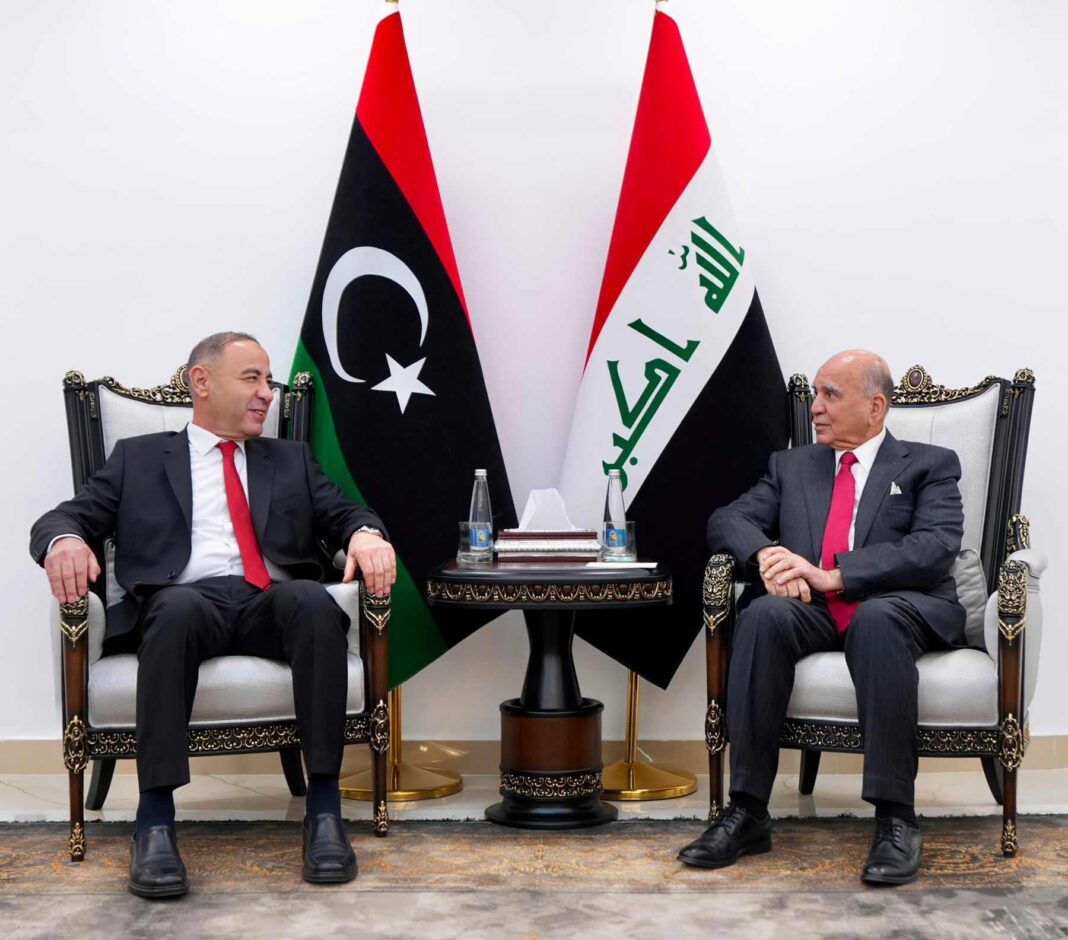
Libya and Iraq are rebuilding Iraq Libya relations after a 25-year pause in their joint committee meetings. Libya’s Acting Foreign Minister Taher al-Baour arrived in Baghdad to lead a senior delegation.
Al-Baour will co-chair meetings of the Iraqi-Libyan Joint Committee with Iraqi Foreign Minister Fuad Hussein. Their discussions aim to strengthen cooperation across political, diplomatic, economic, and regional issues.
The renewed committee meetings mark an important step for bilateral ties. Moreover, both sides want to establish more regular communication between their governments.
During his visit, Al-Baour met with Hussein to discuss shared regional challenges. They also explored ways to coordinate their positions on major political developments.
In addition, the two ministers discussed expanding consular and diplomatic cooperation. Both governments want to improve coordination and strengthen their diplomatic presence.
Following their meeting, Al-Baour and Hussein held a joint press conference in Baghdad. During the conference, the Libyan minister highlighted several urgent priorities for his country.
He said Libya needs Iraqi support to restore and staff important public facilities. Education and healthcare facilities remain particular priorities for the Libyan government.
Therefore, the two countries are exploring practical areas for cooperation beyond diplomatic relations. Economic development and public services could become important parts of their renewed partnership.
Meanwhile, the Libyan delegation is preparing several memoranda of understanding. These agreements will cover various economic, trade, and development sectors.
Officials from several Libyan government institutions joined Al-Baour during his Baghdad visit. The delegation includes representatives linked to Libya’s Government of National Unity.
The visit follows Iraq’s proposal to restore regular coordination with Libya. Baghdad has also expressed interest in returning bilateral relations to a more consistent level.
Furthermore, both countries have already taken steps toward finalizing new trade agreements. Libyan officials previously organized virtual meetings with Iraqi experts and government representatives.
Those discussions focused on preparing agreements before officials formally authorize their signatures. Consequently, the Baghdad meetings provide an opportunity to advance those negotiations.
The renewed diplomatic push could also create new opportunities for Iraqi companies. Libya’s reconstruction needs could generate cooperation across infrastructure and public services.
At the same time, Iraq could benefit from stronger economic links with Libya. Increased trade and investment could further expand cooperation between the two countries.
The return of the joint committee also carries broader diplomatic significance. Iraq Libya relations had remained limited compared with their historical connections.
Now, both governments appear determined to establish a more active bilateral relationship. Regular meetings could help officials address political issues while advancing economic cooperation.
However, translating the renewed diplomatic momentum into agreements will require continued coordination. Both sides must also ensure that proposed memoranda lead to practical projects.
For now, the Baghdad meetings represent a significant step in restoring bilateral engagement. They could also establish a foundation for deeper cooperation across several sectors.
Ultimately, stronger Iraq Libya relations could benefit both countries through expanded diplomacy, trade, investment, and development partnerships.