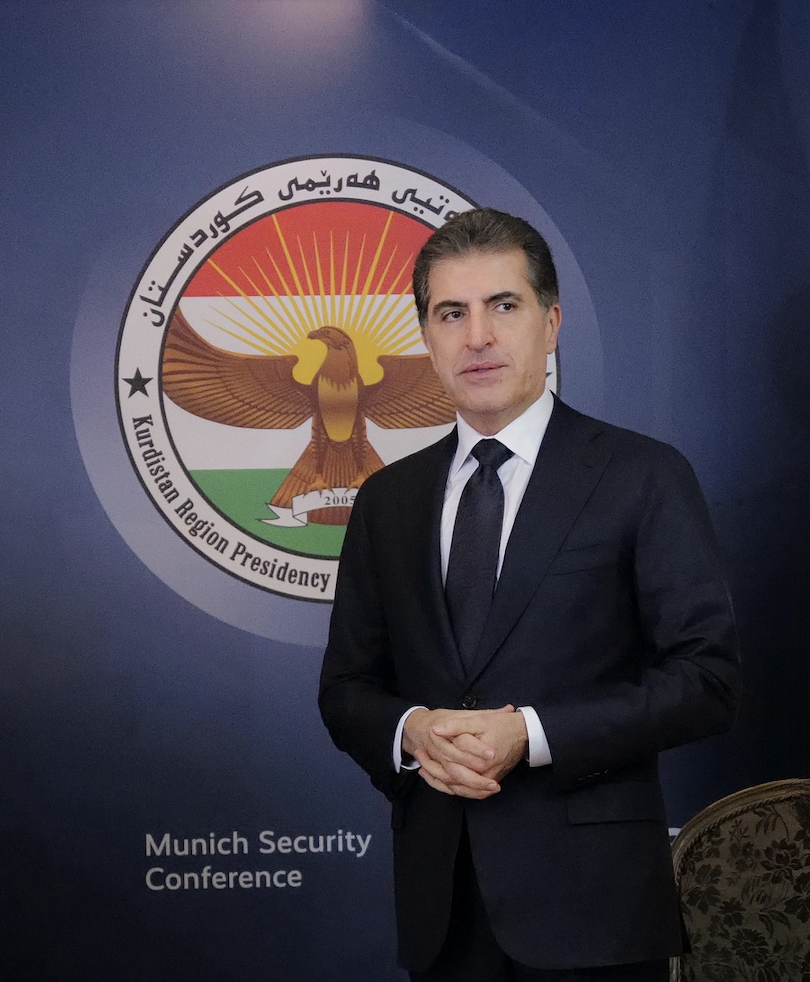
Kurdistan Region President Nechirvan Barzani intensified diplomacy at the Munich Security Conference on Friday. He repeatedly stressed protecting Kurdish rights during a series of high-level meetings. He also focused on security cooperation and regional stability.
First, Barzani met French President Emmanuel Macron on the conference sidelines. They discussed regional security developments and Syria’s political future. Both leaders emphasized safeguarding Kurdish rights in Syria’s future constitution. They also highlighted the need for stability across fragile areas.
France continues to support mediation between Damascus authorities and the Syrian Democratic Forces. That group remains the dominant military force in northeast Syria. Paris helped facilitate a late-January agreement between both sides. Officials view that deal as critical for reducing tensions.
Barzani thanked France for long-standing support and cooperation. He praised French advocacy for Kurdish constitutional rights. Both sides also stressed stronger international coordination. They agreed that cooperation prevents instability from spreading.
Next, Barzani met German Defense Minister Boris Pistorius. They discussed military cooperation between Germany, Iraq, and the Kurdistan Region. He expressed appreciation for Germany’s continued military mission. He also highlighted Berlin’s training support for Peshmerga forces.
Germany reaffirmed commitment to supporting Iraq and the Kurdistan Region. Officials stressed ongoing cooperation to counter terrorism threats. Berlin also linked Syria aid to political stability and minority protections.
Meanwhile, the European Parliament approved a resolution on northeastern Syria stability. Lawmakers called for protecting minorities and preventing a resurgence of Islamic State. The resolution tied future European funding to clear human rights progress.
The European Union recently pledged major recovery funding for Syria. However, officials insisted that assistance must remain conditional. They demanded verifiable improvements in civilian protection and ceasefire compliance.
Barzani also held talks with German development minister Reem Alabali Radovan. They discussed reconstruction projects and humanitarian cooperation. He thanked Germany for supporting displaced communities and Yazidi survivors. He also stressed coexistence and cultural protection.
In addition, Barzani met Qatari Prime Minister Mohammed bin Abdulrahman Al Thani. Both sides highlighted the importance of regional stability. They emphasized international coordination to prevent escalating crises.
He also met Italian Defense Minister Guido Crosetto. Discussions focused on security cooperation and training programs. Italy reaffirmed continued support for Iraqi and Kurdish forces.
These meetings occurred amid renewed diplomacy around Syria’s political transition. Kurdish leaders continue mediation efforts between Damascus and northeastern authorities. Observers note that protecting Kurdish rights remains central to ongoing negotiations. Regional officials also view this issue as key to long-term stability.
Ultimately, Barzani used the conference to strengthen partnerships. He linked security cooperation with political guarantees. He consistently underscored that protecting Kurdish rights supports peace and regional balance.