Kurdish Presidential Impasse has deepened as Iraq’s Shiite Coordination Framework (CF) gave the KDP and PUK 48 hours to agree on a presidential candidate. Lawmaker Dhuha Al-Bahadli told Shafaq News on Tuesday that talks so far have not produced a solution. She emphasized that negotiations are ongoing and that parliament is expected to hold a session on February 5.
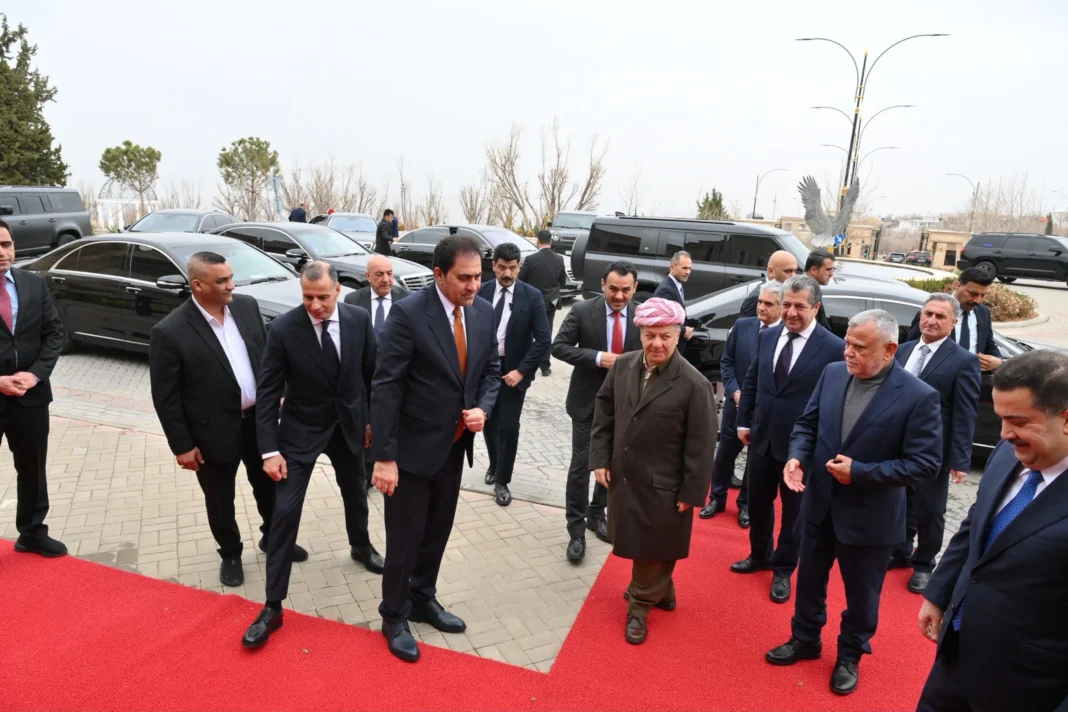
Yesterday, a CF delegation, including caretaker Prime Minister Mohammed Shia Al-Sudani, Hadi Al-Ameri, and Mohsen Al-Mandalawi, met with KDP leader Masoud Barzani in Erbil. They also met PUK leader Bafel Talabani in Al-Sulaymaniyah. Despite these meetings, the Kurdish parties remain divided. The KDP continues to support Fuad Hussein, while the PUK insists on Nizar Amedi.
Earlier, on February 1, parliament had given the Kurdish blocs one week to resolve their differences and proceed with a vote. Al-Bahadli explained that the delay stems partly from U.S. objections to former Prime Minister Nouri Al-Maliki, the CF’s candidate for the premiership. This situation complicates the process because constitutional procedures require parliament to elect a president before naming a prime minister-designate.
The CF delegation sought to bridge the gap between the Kurdish factions, but divisions remain. Analysts note that these talks are critical for Iraq’s broader political stability. Under the country’s power-sharing arrangement, the presidency is reserved for a Kurdish figure, while the premiership is held by a Shiite. Traditionally, the presidency alternates between the KDP and PUK.
Meanwhile, Al-Bahadli emphasized that the Kurdish presidential impasse affects the entire political timetable. Any delay could disrupt other pending appointments and government decisions. Observers also warn that ongoing disagreements may fuel tensions within the CF itself.
Looking ahead, parliament’s session on February 5 will test whether Kurdish leaders can compromise. If the impasse persists, the CF may face pressure to propose alternative mechanisms. Analysts predict a volatile few days as political actors weigh internal and external pressures.
The Kurdish presidential impasse highlights long-standing rivalries and external influences in Iraqi politics. Resolving it is essential to maintain the balance of power and avoid further delays. CF leaders will continue intensive negotiations while actively monitoring the evolving political environment.
Overall, the Kurdish presidential impasse remains a central focus, with limited time to reach an agreement and ensure Iraq’s constitutional processes proceed smoothly.