By Kamiyar Deraney
While the clouds of war have yet to clear from the skies of the Middle East, a new voice is rising between Erbil and Baghdad. Not the sound of gunfire and bombs, but the sound of an agreement that may be able to alleviate some of the major economic crises facing Iraq and the Kurdistan Region. This comes as the war between Israel and the United States against Iran, which began on February 28, 2026, continues, with its effects clearly visible on the global energy market. In mid-March, delegations from both sides met and held talks on resuming the export of Kirkuk oil through the Kurdistan Region’s pipeline to Turkey. This is happening at a time when the Strait of Hormuz, that golden gateway for Arab Gulf oil exports, has been effectively closed due to Iranian military restrictions and an uncertain agreement with the U.S. and Israel.
To understand the importance of this agreement, we must first grasp the depth of the crisis. According to a report published by the International Energy Agency (IEA) on March 12, 2026, the war has created the biggest shock to oil exports in the history of the market. The agency stated that the approximately 20 million barrels per day of crude oil and refined products that passed through the Strait of Hormuz before the war have now almost completely fallen, with only a minimal amount continuing. The IEA further clarified that due to full storage tanks and closed export routes, the Arab Gulf countries were forced to reduce their crude oil production by at least 10 million barrels per day. This led to a drop in total global oil exports in March of around 8 million barrels per day.
According to economic experts, in just the first four weeks of the war, the Gulf states faced $15.3 billion in lost revenue from oil sales. If the damage to production infrastructure is also considered, total losses could exceed $50 billion (Source: Tasnim, March 31, 2026).
In terms of prices, before the start of the war, the price of Brent crude, the main global benchmark, was around $78 per barrel. However, by March 6, 2026, the price had risen to nearly $120 per barrel. Although prices later fell back to between $92 and $98, they remain about $20 to $25 higher than pre-war levels. In this great crisis, Iraq, which previously exported about 3.4 million barrels per day through its southern ports, has now been forced to reduce its production to meet domestic needs.
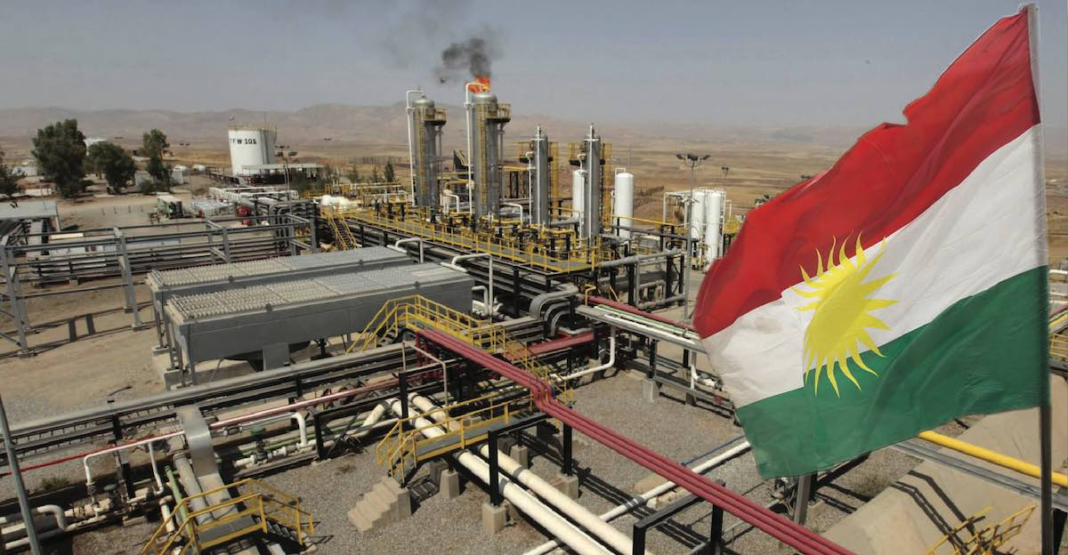
Iraqi Oil Minister Hayan Abdul-Ghani announced on March 16, 2026, that, according to the OPEC quota, Iraq’s production was 4.4 million barrels per day, but after the closure of the Strait of Hormuz, they were forced to reduce production to 1.5–1.6 million barrels per day, which only meets the needs of refineries and power stations. In this context, the Iraqi Oil Minister stated that the Kirkuk-Turkey oil pipeline, which has a capacity of 200,000 to 250,000 barrels per day, could be brought back into operation within a week.
Therefore, he added that hydrostatic testing work along the remaining approximately 100 kilometers would be completed in the coming days, and Kirkuk oil could be sent directly to Turkey’s Ceyhan port without passing through the Kurdistan Region. On the other hand, the Kurdistan Region showed a different approach. On March 17, 2026, the Region’s negotiating delegation announced that, within the framework of national responsibility, they were ready to take all necessary steps to increase public treasury revenues and help Iraq resolve its financial crisis.
The official report stated that both sides had agreed to export Kirkuk oil alongside oil from Kurdistan Region fields through the same Kurdistan-Ceyhan pipeline, with all revenues returning to Iraq’s federal treasury. It was also agreed to form a joint committee to carry out technical and administrative steps and provide necessary security measures to protect oil fields and ensure continuous exports. At a time when Iraq is facing a major budget deficit, this agreement is like a lifeline to escape the crisis.
According to some reports, exports began on March 17 at a rate of approximately 250,000 barrels per day. If the price of oil is set at $95 per barrel, this would generate roughly $23.75 million per day and about $712.5 million per month for Iraq. At a time when most normal export routes are closed, this money will be a breath of life for Iraq’s weakened economy.
On the other hand, the Iraqi government has officially stated its commitment to regularly paying the salaries of employees in the Kurdistan Region, provided the Region adheres to the agreement and oil exports continue. This means the salaries of approximately 1.2 million employees and civil servants in the Region, some of which have been delayed for months, could be regulated and paid properly as a result.
From a broader perspective, despite the disagreements, this agreement shows that both sides understand the need to work together in times of crisis. Iraq, which relies on oil for 85% to 90% of its revenue, is forced to use every possible export option. Meanwhile, the Kurdistan Region, deep in an economic crisis due to budget shortfalls and unpaid salaries, desperately needs a radical solution.
In short, the reality can be summarized in a few sentences: The resumption of oil exports and the agreement between the two sides are good for both Iraq and Kurdistan. Because it helps Iraq escape the crisis of the Hormuz closure and the indirect war between Iran and Israel–America, and it leads the Kurdistan Region toward financial stability and the strengthening of its position within the framework of Iraq.
The road is still long, but this agreement from mid-March could become an example of how, when external pressures create instability, internal actors are forced to find shared ways to adapt. As the IEA has stated: “Unless oil transit routes through the Strait of Hormuz are quickly restored, all efforts to resolve the crisis will only be temporary solutions.”