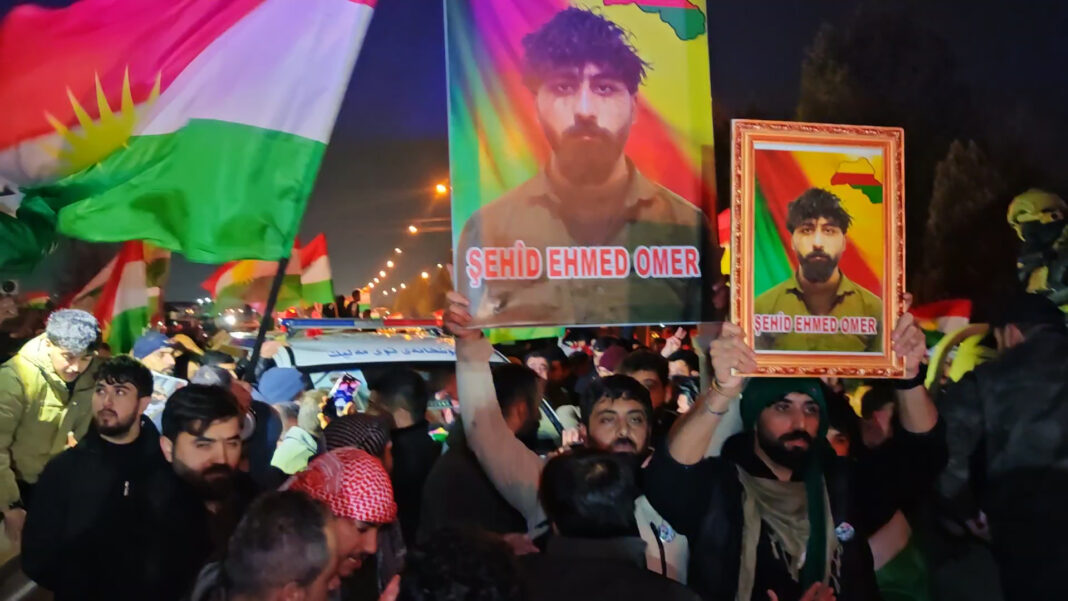
Thousands of Kurds attended the funeral of Ahmed Hemin, a volunteer from the Kurdistan Region to Rojava, on Saturday. His body was laid to rest at Rahimawa Cemetery in Kirkuk. The ceremony drew participants from across Kurdistan, including friends and family of the deceased.
Ahmed Hemin, a young man from Kirkuk, traveled to Rojava with friends after attacks on Kurdish areas by Syrian government forces and allied militias. There, he went to support the Kurds and ultimately died defending their territory.
Meanwhile, as his body traveled from Rojava to the Kurdistan Region, residents gathered along the route in Zakho, Erbil, and Kirkuk. Many waved Kurdistan flags to honor Hemin as the coffin passed through their communities.
Furthermore, a participant told 964media, “Being Kurdish is very painful. I cannot describe how I feel. Why must we continue to face attacks?” In response, mourners repeatedly chanted, “Martyrs never die,” highlighting the depth of Kurdish solidarity.
Hemin Kirkuki, the father of Ahmed, expressed gratitude for the support shown across Kurdistan. “Our heads are held high. The solidarity of the people has eased our grief,” he said. His grandfather, Omar Ahmed, also thanked people for the warm reception. “Thanks to all Kurds, from Hasakah to here, and from all four parts of Kurdistan,” he added.
In addition, Activists in Kirkuk will keep the coffin that transported Ahmed’s body from Rojava. They will display it as a symbol during demonstrations supporting the region. Civil activist Nabard Kakayi said Ahmed’s family requested this decision. Volunteers placed a Kurdistan flag on the coffin to show what Hemin died for.
Meanwhile, Syria’s government and the Kurdish-led Syrian Democratic Forces reached an agreement Friday. The deal will gradually integrate Kurdish military and civil institutions after weeks of clashes ended in a ceasefire.
During the attacks, Kurds worldwide mobilized in what activists called an unprecedented show of Kurdish solidarity. Protests continued for over a week in the Kurdistan Region and the diaspora. Demonstrators condemned the assaults and demanded international action.
Ultimately, several organizations launched humanitarian campaigns to support civilians affected by the fighting. Activists as well as ordinary people used social media to document atrocities committed by the Syrian regime. The global response emphasized the reach and power of Kurdish solidarity.