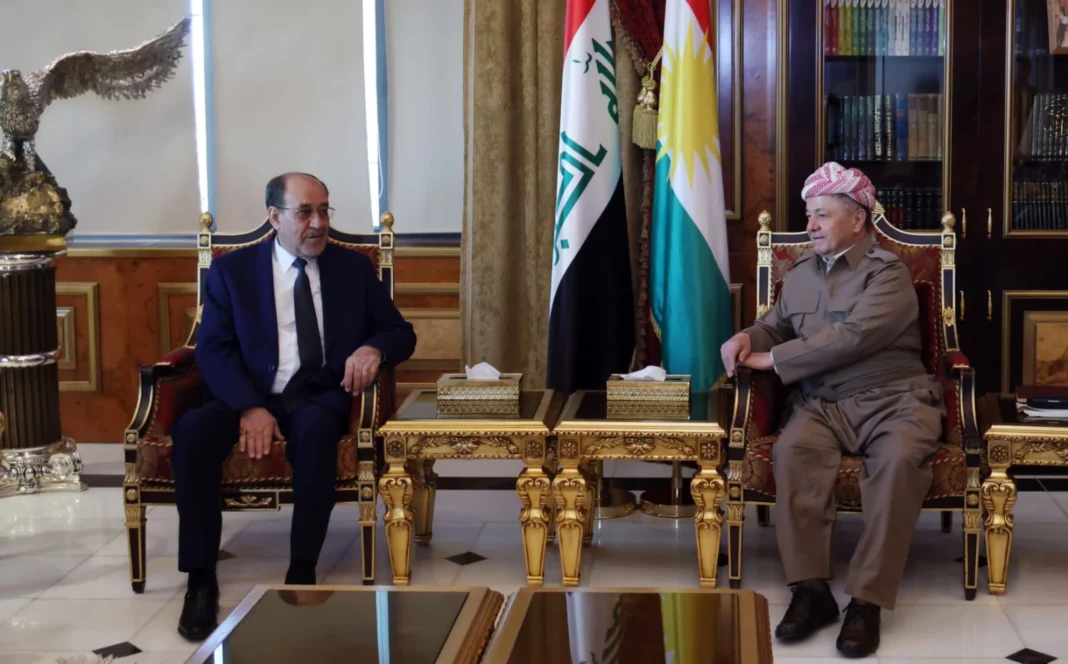
Iraq Political Talks intensified on Saturday as former Iraqi prime minister Nouri al-Maliki arrived in Erbil for high-level meetings with senior Kurdish leaders. These meetings gained greater importance because political blocs continued to push for faster progress on forming Iraq’s next government. Iraq Political Talks now dominate discussions across Baghdad and Erbil.
Maliki reached the Kurdish capital following an invitation from President Masoud Barzani. Barzani, who leads the Kurdistan Democratic Party, hosted the visit to advance ongoing negotiations. Maliki’s media advisor, Husham al-Rikabi, confirmed the visit and emphasized the direct nature of the invitation. Rikabi also stressed Maliki’s intention to address several major files with Kurdish officials.
The former prime minister arrived as key blocs increased their coordination. Maliki, a senior figure in the Shiite Coordination Framework, came to Erbil to discuss the three federal presidencies and several related political issues. These discussions gained urgency because Iraq recently completed its national elections.
Iraq held early legislative voting on November 9 and followed with its general vote on November 11. The Independent High Electoral Commission released final results on Monday. Mohammed Shia’ al-Sudani’s Reconstruction and Development Coalition won 46 seats and entered negotiations with stronger leverage.
Meanwhile, the Kurdistan Democratic Party secured more than 1.1 million votes and gained 27 seats. The State of Law Coalition, led by Maliki, received around 710,000 votes and won 29 seats. These results reshaped alliances and increased pressure on parties to form a working majority.
Shortly after the electoral announcement, the Shiite Coordination Framework declared itself the largest parliamentary bloc. This move positioned the bloc to name the next prime minister, a step that always shapes Iraq’s political landscape. Iraq Political Talks therefore shifted toward negotiations over leadership positions and coalition structures.
Since 2003, Iraq has followed an informal power distribution. Shiites take the premiership, Sunni Arabs hold the speakership, and Kurds lead the presidency. This arrangement continues to guide bargaining between major blocs.
The constitution now requires parliament to convene with a two-thirds quorum. The eldest member will chair the first session and oversee the election of a speaker. Lawmakers must then elect a president through a secret ballot. After that stage, the largest bloc will nominate a prime minister to form the next cabinet.
The Coordination Framework already created two committees. One committee negotiates national entitlements and another interviews potential candidates for prime minister. These coordinated steps show the bloc’s readiness to move quickly.
Several names now circulate as potential prime ministers. These include Maliki, Sudani, Mustafa al-Kadhimi, Qasem al-Araji, Hamid al-Shatri, Abdul-Amir al-Shammari, and Asaad al-Eidani. Their meetings and statements keep shaping the next phase of negotiations.
Overall, political actors continue to intensify their efforts. Every meeting, statement, and committee decision increases momentum as Iraq enters a defining stage in its government formation process.